Myxines (hagfishes) >
Myxiniformes (Hagfishes) >
Myxinidae (Hagfishes) > Eptatretinae
Etymology: Eptatretus: hepta (Gr.), seven; tretos (Gr.), perforated (i.e., with holes), referring to seven gill apertures on what would later be described as Homea banksii (=E. cirrhatus) [range within genus is 6-14 pairs of gill apertures] (See ETYFish); alastairi: In honor of Alastair Graham (b. 1964), Fish Collection Manager, CSIRO (Commonwealth Scientific and Industrial Research Organisation), Canberra, Australia, for help and hospitality offered to second author (See ETYFish).
Eponymy: Alastair Graham (d: 1964) was honoured for help and hospitality offered to the second author. (See Graham, also see Al Graham) (Ref. 128868), visit book page.
Environnement : milieu / zone climatique / profondeur / gamme de distribution
Écologie
marin bathydémersal; profondeur 380 - 550 m (Ref. 85052). Tropical
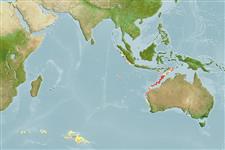
Eastern Indian Ocean: Western Australia.
Taille / Poids / Âge
Maturité: Lm ? range ? - ? cm
Max length : 49.5 cm TL mâle / non sexé; (Ref. 85052)
Description synthétique
Clés d'identification | Morphologie | Morphométrie
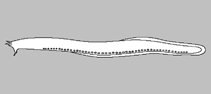
This species differs from all its congeners except for the western Atlantic species (E. mendozai, E. minor and E. multidens) by possessing 6 pairs of gill pouches and three-cusp multicusps on the anterior and posterior rows of cusps. It differs from E. mendozai in number of total cusps (48-56 vs. 56-61), trunk pores (50-55 vs. 48-48) and total pores (83-88 vs. 77-82; from E. minor in number of prebranchial pores (13-16 vs. 15-18), trunk pores (50-55 vs. 41-48) and total pores (83-88 vs. 74-82); and from E. multidens by its number of tail pores (11-13 vs. 15-16) and total pores (83-88 vs. 88-93) (Ref. 85052).
Body shape (shape guide): eel-like; Cross section: oval.
Iteroparous (Ref. 94918).
Cycle de vie et comportement reproducteur
Maturité | Reproduction | Frai | Œufs | Fécondité | Larves
Iteroparous (Ref. 94918).
Mincarone, M.M. and B. Fernholm, 2010. Review of the Australian hagfishes with description of two new species of Eptatretus (Myxinidae). J. Fish Biol. 77(4):779-801. (Ref. 85052)
Statut dans la liste rouge de l'IUCN (Ref. 130435: Version 2025-2 (Global))
Menace pour l'homme
Harmless
Utilisations par l'homme
Pêcheries: sans intérêt
Outils
Articles particuliers
Télécharger en XML
Sources Internet
Estimations basées sur des modèles
Température préférée (Réf.
123201): 1.3 - 10.6, mean 5.3 °C (based on 12 cells).
Indice de diversité phylogénétique (Réf.
82804): PD
50 = 0.5000 [Uniqueness, from 0.5 = low to 2.0 = high].
Bayesian length-weight: a=0.00204 (0.00094 - 0.00444), b=2.92 (2.72 - 3.12), in cm total length, based on LWR estimates for this (Sub)family-body shape (Ref.
93245).
Niveau trophique (Réf.
69278): 4.2 ±0.7 se; based on size and trophs of closest relatives
Résilience (Réf.
120179): Milieu, temps minimum de doublement de population : 1,4 à 4,4 années (Preliminary K or Fecundity.).
Vulnérabilité de la pêche (Ref.
59153): Moderate vulnerability (40 of 100).
🛈