>
Perciformes/Serranoidei (Groupers) >
Anthiadidae (Fairy basslets or Streamer basses)
Etymology: Meganthias: Name from Greek 'megas' for large and 'anthias' for Mediterranean fish, refers to the size of the 2 species, larger than species of Odontanthias which do not exceed 20.4 cm SL; filiferus: Name from the Latin 'filum' for thread or filament and suffix '-fer' meaning to bear, referring to the very long dorsal= and caudal-fin filaments.
More on authors: Randall & Heemstra.
Ambiente: milieu / zona climática / intervalo de profundidade / gama de distribuição
Ecologia
marinhas pelagic-neritic; intervalo de profundidade ? - 150 m (Ref. 84847). Tropical
Indian Ocean: Thailand (Andaman Sea) (Ref. 84847) and SW coast of India (Arabian Sea (Ref. 86260).
Tamanho / Peso / Idade
Maturidade: Lm ? range ? - ? cm
Max length : 29.3 cm SL macho/indeterminado; (Ref. 84847)
Descrição breve
Chaves de identificação | Morfologia | Morfometria
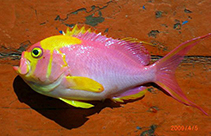
Espinhos dorsais (total) : 10; Raios dorsais moles (total) : 18; Espinhos anais: 3; Raios anais moles: 8. This species is distinguished by the following characters: D X,18; A III,8; pectoral rays 17; lateral-line scales 44; gill rakers 12 + 25; body depth 2.05 in SL; head length 2.5 in SL; orbit diameter 4.5 in HL; with accessory scales, dense on head and nape; scales dorsally on snout extending forward to upper lip; small scales cover mandible; rugose lips from dense papillae, enlarged on front of lower lip; maxilla nearly reaching a vertical at rear edge of eye, its posterior end and corners slightly rounded; each side at front of upper jaw with 6 short and stout conical teeth, projecting slightly upward and fully exposed when mouth closed (along with most of the villiform teeth); no teeth on tongue; preopercle corner strongly angular, no spine, upper margin finely serrate, while the lower one is crenulate; dorsal spines progressively longer, the tenth 3.2 in HL; second and third dorsal soft rays prolonged as a very long filament, ray length 1.5 in SL; lunate caudal fin with extremely long filamentous lobes, fin length 1.1 in SL; third anal spine longer than second, 2.95 in HL; preserved color in alcohol pale yellowish with black edges on the last 6 interspinous membranes of dorsal fin, when fresh, pink and yellow (Ref. 84847).
Body shape (shape guide): short and / or deep; Cross section: compressed.
Ciclo de vida e comportamento de acasalamento
Maturidade | Reprodução | Desova | Ovos | Fecundidade | Larvas
Randall, J.E. and P.C. Heemstra, 2008. Meganthias filiferus, a new species of anthine fish (Perciformes: Serranidae), from the Andaman Sea off southwestern Thailand. Phuket Marine Biological Center Res. Bull., 68: 5-9. (Ref. 84847)
Categoria na Lista Vermelha da IUCN (Ref. 130435: Version 2025-2 (Global))
Ameaça para o homem
Harmless
Utilização humana
Ferramentas
Relatórios especiais
Descarregue XML
Fontes da internet
Estimativas baseadas em modelos
Índice de diversidade filogenética (Ref.
82804): PD
50 = 0.5625 [Uniqueness, from 0.5 = low to 2.0 = high].
Bayesian length-weight: a=0.02512 (0.00978 - 0.06451), b=2.98 (2.75 - 3.21), in cm total length, based on LWR estimates for this (Sub)family-body shape (Ref.
93245).
Nível Trófico (Ref.
69278): 3.6 ±0.5 se; based on size and trophs of closest relatives
Resiliência (Ref.
120179): Médio, tempo mínimo de duplicação da população 1,4 - 4,4 anos (Preliminary K or Fecundity.).
Vulnerabilidade da pesca (Ref.
59153): Low to moderate vulnerability (26 of 100).
🛈