Klassifizierung / Names
Namen | Synonyme | Catalog of Fishes(Gattung, Arten) | ITIS | CoL | WoRMS | Cloffa
>
Ovalentaria/misc (Various families in series Ovalentaria) >
Opistognathidae (Jawfishes)
Etymology: Opistognathus: Greek, opisthe = behind + Greek, gnathos = jaw (Ref. 45335); to the very elongate upper jaw of the type species of the genus, Opistognathus nigromarginatus (Ref. 128653); randalli: Named for Dr. John E. Randall.
Eponymy: Dr John ‘Jack’ Ernest Randall Jr. [...] (Ref. 128868), visit book page.
Umwelt: Milieu / Klimazone / Tiefenbereich / Verbreitungsgebiet
Ökologie
seewasser pelagic-neritic; tiefenbereich 5 - 32 m (Ref. 81517). Tropical
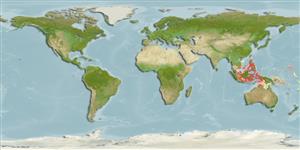
Western Pacific: Indonesia, eastern Borneo and the Philippines.
Größe / Gewicht / Alter
Geschlechtsreife: Lm ? range ? - ? cm
Max length : 10.4 cm SL Männchen/unbestimmt; (Ref. 81517); 10.9 cm SL (female)
Kurzbeschreibung
Bestimmungsschlüssel | Morphologie | Morphometrie
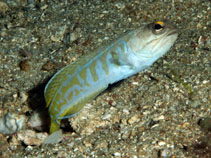
Rückenflossenstacheln (insgesamt) : 11; Rückenflossenweichstrahlen (insgesamt) : 14 - 16; Afterflossenstacheln: 3; Afterflossenweichstrahlen: 14 - 15; Wirbelzahl: 28. This species is distinguished by the following characters: elongate supramaxilla and posterior end of maxilla produced as a thin flexible lamina; a single conspicuous black stripe at inner lining of upper jaw and adjacent membranes; dorsal, anal and caudal fins with narrow, pale (blue in life) distal margins; when alive, dorsal portion of iris golden; lateral-line terminus below verticals between segmented dorsal-fin rays 1 to 4, typically below second to third ray; caudal vertebrae 18 (Ref. 81517).
Body shape (shape guide): elongated; Cross section: oval.
Males of this species are strongly territorial and frequently engage in jaw locking combat, apparently to evict rivals or confiscate their burrows (Ref. 81517). Found in sand/rubble bottoms near reefs in about 5-30 m (Ref 90102).
Lebenszyklus und Paarungsverhalten
Geschlechtsreife | Fortpflanzung | Ablaichen | Eier | Fruchtbarkeit | Larven
Smith-Vaniz, W.F., 2009. Three new species of Indo-Pacific jawfishes (Opistognathus: Opistognathidae), with the posterior end of the upper jaw produced as a thin flexible lamina. aqua, Int. J. Ichthyol. 15(2):69-108. (Ref. 81517)
IUCN Rote Liste Status (Ref. 130435: Version 2025-2 (Global))
Bedrohung für Menschen
Harmless
Nutzung durch Menschen
Tools
Zusatzinformationen
Download XML
Internet Quellen
Schätzungen auf der Grundlage von Modellen
Bevorzugte Temperatur (Ref.
123201): 28.4 - 29.3, mean 28.8 °C (based on 778 cells).
Phylogenetischer Diversitätsindex (Ref.
82804): PD
50 = 0.5000 [Uniqueness, from 0.5 = low to 2.0 = high].
Bayesian length-weight: a=0.00389 (0.00180 - 0.00842), b=3.12 (2.94 - 3.30), in cm total length, based on all LWR estimates for this body shape (Ref.
93245).
Trophische Ebene (Ref.
69278): 3.5 ±0.6 se; based on size and trophs of closest relatives
Anfälligkeit der Fischerei (Ref.
59153): Low vulnerability (10 of 100).
🛈
Nährstoffe (Ref.
124155): Calcium = 326 [174, 606] mg/100g; Iron = 1.61 [0.92, 2.70] mg/100g; Protein = 17.8 [16.7, 18.8] %; Omega3 = 0.174 [0.091, 0.341] g/100g; Selenium = 32.4 [13.1, 73.7] μg/100g; VitaminA = 46.5 [14.7, 144.0] μg/100g; Zinc = 2.27 [1.56, 3.22] mg/100g (wet weight);