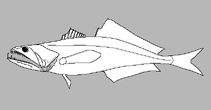
Classification / Noms
Noms communs | Synonymes | Catalog of Fishes(Genre, Espèce) | ITIS | CoL | WoRMS | Cloffa
>
Scombriformes (Mackerels) >
Chiasmodontidae (Snaketooth fishes)
Etymology: Chiasmodon: Name from the Greek 'chiasmos' which means diagonally arranged, and 'odous' for tooth or teeth; harteli: Named for Karsten Hartel (MCZ), in recognition of his lifetime contribution to
ichthyology, in particular to the comprehension of deep-sea fish fauna.
Eponymy: Karsten Edward Hartel is an ichthyologist who joined (1975) the Museum of Comparative Zoology, Harvard University. [...] (Ref. 128868), visit book page.
Environnement : milieu / zone climatique / profondeur / gamme de distribution
Écologie
marin pelagic-oceanic; profondeur 495 - 1417 m (Ref. 82429). Subtropical; 70°N - 30°N, 40°W - 11°W
Northeastern and western Atlantic.
Taille / Poids / Âge
Maturité: Lm ? range ? - ? cm
Max length : 19.8 cm SL mâle / non sexé; (Ref. 82429)
Description synthétique
Clés d'identification | Morphologie | Morphométrie
This species is distinguished from its congeners by having 47-48 total vertebrae (vs. 42-46) and with 6 supraorbital pores (vs. 7 or 8). It further differs from C. braueri by teeth on the second ceratobranchial absent (vs. present); from C. microcephalus by 3-18 teeth on second basibranchial 18, rarely 2, often present on second hypobranchial (vs. usually no teeth on second basibranchial, rarely 1-3); from C. niger having by 89-95 lateral-line pores (vs. 86-90); from C. pluriradiatus and C. asper by having 13-14 pectoral-fin rays (vs. 15-16); no tiny dermal spinules on body in specimens larger than 48.7 mm (vs. spinules present), one fang on premaxillary head (vs. 2), 7 supraorbital pores (vs. 8 in C. pluriradiatus, 9 in C. asper); from C. subniger by having 13-16 (usually 14) infraorbital pores, infraorbital 1 pores seven to eight (vs. 11-13 infraorbital pores, infraorbital 1 pores five to six), snout elongate and pointed, 23.0-26.6% HL (vs. short and blunt, 21.4-23.9% HL), upper jaw 74.3-84.2% HL (vs. 63.9-72.7% HL); lower jaw 80.8-89.9% HL (vs. 69.0-76.7% HL), and 90-95 lateral-line pores (vs. 75-87) (Ref. 82429).
Body shape (shape guide): fusiform / normal.
Found in the mesopelagic to bathypelagic zones (Ref. 82429).
Cycle de vie et comportement reproducteur
Maturité | Reproduction | Frai | Œufs | Fécondité | Larves
Melo, M.R.S., 2009. Revision of the genus Chiasmodon (Acanthomorpha: Chiasmodontidae), with description of two new species. Copeia 2009(3):583-608. (Ref. 82429)
Statut dans la liste rouge de l'IUCN (Ref. 130435: Version 2025-2 (Global))
Menace pour l'homme
Harmless
Utilisations par l'homme
Outils
Articles particuliers
Télécharger en XML
Sources Internet
Estimations basées sur des modèles
Indice de diversité phylogénétique (Réf.
82804): PD
50 = 0.5078 [Uniqueness, from 0.5 = low to 2.0 = high].
Bayesian length-weight: a=0.01096 (0.00417 - 0.02880), b=3.03 (2.80 - 3.26), in cm total length, based on LWR estimates for this (Sub)family-body shape (Ref.
93245).
Niveau trophique (Réf.
69278): 3.7 ±0.2 se; based on size and trophs of closest relatives
Vulnérabilité de la pêche (Ref.
59153): Low vulnerability (14 of 100).
🛈