Classification / Noms
Noms communs | Synonymes | Catalog of Fishes(Genre, Espèce) | ITIS | CoL | WoRMS | Cloffa
>
Cypriniformes (Carps) >
Leuciscidae (Minnows) > Leuciscinae
Etymology: janae: Named for Jana Zupančič.
Eponymy: Jana Zupančič is, presumably, related to the junior author but we have not been able to establish how. The etymology says that her ‘enormous patience and assistance’ made the authors’ study possible. (Ref. 128868), visit book page.
Environnement : milieu / zone climatique / profondeur / gamme de distribution
Écologie
; eau douce pélagique. Temperate
Europe: known only from the River Dragonja drainage of Slovenia and Croatia.
Taille / Poids / Âge
Maturité: Lm ? range ? - ? cm
Max length : 19.1 cm SL mâle / non sexé; (Ref. 84537)
Description synthétique
Clés d'identification | Morphologie | Morphométrie
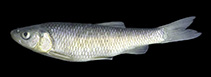
This species is distinguished from its congeners in the Adriatic basin by a combination of characters: head long, length, 29?32% SL, always markedly greater than body depth; snout pointed and conical; slightly subterminal mouth with clear projecting upper jaw; mouth cleft straight, oblique; lower-jaw length, 39?46% HL, exceeding caudal-peduncle depth; eye large, its diameter 19?25% HL; fifth infraorbital large and triangular; marked discontinuity between the dorsal profile of head and body; total lateral-line scales usually 44-47; branched anal-fin rays usually 9½; total vertebrae usually 44, vertebral formulae 24+20 and 25+19; body colouration strong silvery tint; scales easily lost; iris, pectoral, pelvic and anal-fin pigmentation with yellow shades; flank scales margined by a few black pigment dots along their free margin and intense black pigments on the scale pockets, forming black, vertically elongate spots (Ref. 84537).
Body shape (shape guide): fusiform / normal.
Specimens were collected from small rivers which become shallow in summer, often partly dried, and where fish survive in remaining pools. The river flows over a bare limestone bed, alternating with silted pools and the Dragonja section had clear and colorless water, temperature of 21.4°C, pH 8.8, a mineralization of 0.32 gl-1, and has slow current. No other fishes were caught in the stream. Both females and males adults with completely ripe gonads, were found in the middle of May and at the beginning of July; post-spawning adults in July. The smallest mature male was 10.14 cm SL and adult males retain the nuptial tubercles until at least August. Stomach contents of specimens collected (April 10, 2009) upstream from the confluence of Dragonja and Pinjevec, contained no food, while those collected at the same date but 5 km downstream, contained algae, plant remains and detritus; the difference is coincident with the spring water temperature rise and start of plant growth in the areas of sampling (Ref. .84537).
Cycle de vie et comportement reproducteur
Maturité | Reproduction | Frai | Œufs | Fécondité | Larves
Bogutskaya, N.G. and P. Zupančič, 2010. Squalius janae, a new species of fish from the Adriatic Sea basin in Slovenia (Actinopterygii:Cyprinidae). Zootaxa 2536:53-68. (Ref. 84537)
Statut dans la liste rouge de l'IUCN (Ref. 130435: Version 2025-2 (Global))
Menace pour l'homme
Harmless
Utilisations par l'homme
Outils
Articles particuliers
Télécharger en XML
Sources Internet
Estimations basées sur des modèles
Indice de diversité phylogénétique (Réf.
82804): PD
50 = 0.5000 [Uniqueness, from 0.5 = low to 2.0 = high].
Bayesian length-weight: a=0.00794 (0.00402 - 0.01570), b=3.13 (2.97 - 3.29), in cm total length, based on LWR estimates for this Genus-body shape (Ref.
93245).
Niveau trophique (Réf.
69278): 3.3 ±0.4 se; based on size and trophs of closest relatives
Résilience (Réf.
120179): Milieu, temps minimum de doublement de population : 1,4 à 4,4 années (Preliminary K or Fecundity.).
Vulnérabilité de la pêche (Ref.
59153): Low vulnerability (13 of 100).
🛈