>
Blenniiformes (Blennies) >
Chaenopsidae (Pike-, tube- and flagblennies)
Etymology: Acanthemblemaria: Greek, akantha = thorn + Greek, emblema, -atos, anything that is nailed, knocked in; also anything with bass or high relief (Ref. 45335); hastingsi: Named for Philip A. Hastings.
Eponymy: Dr Philip Alan ‘Phil’ Hastings (d: 1951) is Professor of Marine Biology at Scripps Institution of Oceanography, University of California, San Diego and Curator of Marine Vertebrates. [...] (Ref. 128868), visit book page.
Ambiente: milieu / zona climatica / distribuzione batimetrica / gamma di distribuzione
Ecologia
marino demersale; distribuzione batimetrica 1 - 3 m (Ref. 84469). Tropical
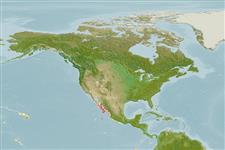
Eastern Pacific: Gulf of California (limited to Mulegé to Cabo San Lucas along the Baja Peninsula and between Isla San Pedro Nolasco and Isla San Ignacio de Farallon along the Mexican continental mainland, Ref. 26771).
Dimensione / Peso / Età
Maturità: Lm ? range ? - ? cm
Max length : 5.1 cm SL maschio/sesso non determinato; (Ref. 84469); 4.0 cm SL (female)
Breve descrizione
Chiavi di identificazione | Morfologia | Morfometria
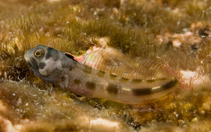
Spine dorsali (totale) : 23 - 25; Raggi dorsali molli (totale) : 12 - 14; Spine anali: 2; Vertebre: 42 - 44. This species is distinguished from its congeners in the Pacific, excluding its closest relatives, A. macrospilus and A. mangognatha, by having a single row of large brown blotches along its lateral midline and head spines that are pointed (vs. club-like or ridge-like). It differs from the 2 latter species by having a dark swath of melanophores on the dorsal fin in both males and females that highlights the bright orange coloration on that fin; presence of scattered melanophores reaching the tip of the lower jaw; and expression of orange as the primary bright head color. This species is further distinguishable from A. macrospilus by the 71 fixed mutations in COI and 20 fixed mutations in the D-loop region of its mitochondrial genome (Ref, 84469).
Body shape (shape guide): elongated.
Ciclo vitale e comportamento di accoppiamento
Maturità | Riproduzione | Deposizione | Uova | Fecondità | Larve
Lin, H.-C. and G.R. Galland, 2010. Molecular analysis of Acanthemblemaria macrospilus (Teleostei: Chaenopsidae) with descriptions of a new species from the Gulf of California, Mexico. Zootaxa 2525:51-62. (Ref. 84469)
Stato della Lista Rossa IUCN (Ref. 130435: Version 2025-2 (Global))
Minaccia per l'uomo
Harmless
Usi umani
Strumenti
Rapporti speciali
Scarica XML
Fonti Internet
Stime basate su modelli
Temperatura preferita (Fonte Biblio.
123201): 23.2 - 28.7, mean 25.6 °C (based on 138 cells).
Indice di diversità filogenetica (Fonte Biblio.
82804): PD
50 = 0.5000 [Uniqueness, from 0.5 = low to 2.0 = high].
Bayesian length-weight: a=0.00525 (0.00224 - 0.01232), b=3.07 (2.86 - 3.28), in cm total length, based on LWR estimates for this (Sub)family-body shape (Ref.
93245).
Livello trofico (Fonte Biblio.
69278): 3.4 ±0.4 se; based on size and trophs of closest relatives
Vulnerabilità della pesca (Ref.
59153): Low vulnerability (10 of 100).
🛈