Classificatie / Namen
Lokale namen | Synoniemen | Catalog of Fishes(Genus, Soort(en)) | ITIS | CoL | WoRMS | Cloffa
>
Siluriformes (Catfishes) >
Sisoridae (Sisorid catfishes) > Sisorinae
Etymology: Glyptothorax: Greek, glyptes = carver + Greek, thorax = breast (Ref. 45335); malabarensis: Named for the older name for the region of northern Kerala, (‘Malabar’) in which this species occurs.
Milieu: milieu / Klimaatzone / Diepte / verspreidingsgebied
Ecologie
; zoet water benthopelagisch; diepte 0 - 2 m (Ref. 84486). Tropical
Asia: India.
Grootte / Gewicht / Leeftijd
Maturiteit: Lm ? range ? - ? cm
Max length : 5.5 cm SL mannelijk / geslacht onbekend; (Ref. 84486)
Korte beschrijving
Determinatiesleutels | Morfologie | Morfometrie
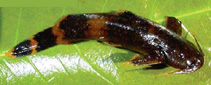
This species is distinguished from its congeners in peninsular India by the following set of characters: body depth at dorsal-fin origin, 19.6-19.9% SL; caudal-peduncle length 14.3-14.7% SL, depth 12.4-12.7 % SL, 86.4-88.1% its length; thoracic adhesive apparatus approximately pentagonal, as long as broad, with no median depression; skin of head and body minutely granulated; color when alive consists of a black background with 3 flesh-red or orange transverse bands on the body and when preserved, changing to dark-grey with black mottling and 3 whitish transverse bands. It differs from G. anamalaiensis, which most closely resembles it in the Indian peninsula, by its body depth (vs. 12.9-16.8% SL), deeper caudal peduncle (vs. 34.1-37.8% its length), longer nasal barbels reaching the anterior margin of the orbit (vs. reaching only half the distance to the orbit), and the thoracic adhesive apparatus (vs. adhesive apparatus broader than long, inverted V-shaped with short unculiferous ridges) (Ref. 84486).
Body shape (shape guide): elongated.
Specimens were collected from submerged crevices formed by large boulders in an upland stream (210 m a.s.l.), which is about 6 m wide and 0.5-1.5 m deep, flowing through a forest patch on the western slopes of the Western Ghats in Kerala. The streambed in this area is composed of pebble and sand in which are embedded large boulders. Collection was done in February, a relatively dry month, and the stream was in a depleted phase with clear- but not fast flowing-water. Riparian forest vegetation in the vicinity of the stream provided ample shade. Associated fishes from the collection site included Barilius bakeri Day, Garra mullya (Sykes) (Cyprinidae); Bhavania australis (Jerdon) and Schistura denisoni denisoni (Day) (Balitoridae), from the pebble-bottomed area of the stream (Ref. 84486).
Levenscyclus en paargedrag
Maturiteit | Voortplanting | Paaien | Eieren | Fecunditeit | Larven
Gopi, K.C., 2010. Glyptothorax malabarensis, a new catfish (Teleostei: Sisoridae) from the Western Ghats of Kerala, India. Zootaxa 2528:53-60. (Ref. 84486)
Status op de Rode Lijst van het IUCN (Ref. 130435: Version 2025-2 (Global))
Gevaar voor de mens
Harmless
Gebruik door de mens
Visserij: van geen belang
Tools
Speciale rapporten
Download XML
Internetbronnen
Schattingen op basis van modellen
Fylogenetische diversiteitsindex (Ref.
82804): PD
50 = 0.5000 [Uniqueness, from 0.5 = low to 2.0 = high].
Bayesian length-weight: a=0.00794 (0.00365 - 0.01726), b=3.02 (2.85 - 3.19), in cm total length, based on LWR estimates for this Genus-body shape (Ref.
93245).
Trofisch niveau (Ref.
69278): 3.1 ±0.4 se; based on size and trophs of closest relatives
Kwetsbaarheid van de visserij (Ref.
59153): Low vulnerability (10 of 100).
🛈