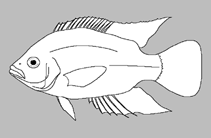
Klassifizierung / Names
Namen | Synonyme | Catalog of Fishes(Gattung, Arten) | ITIS | CoL | WoRMS | Cloffa
>
Cichliformes (Cichlids, convict blennies) >
Cichlidae (Cichlids) > Ptychochrominae
Etymology: Ptychochromis: Greek, ptyx, = fold + Greek, chromis = a fish, perhaps a perch (Ref. 45335); ernestmagnusi: Named in honor of Mr. Ernest Magnus of Berlin, Germany, and New York City, at the request of the family of Dr. Rudolph G. Arndt, whose support of ichthyological exploration and research at the American Museum of Natural History is gratefully acknowledged (Ref. 83427).
Eponymy: Ernest Magnus (1908–1983) was honoured at the request of the family of Rudolf G Arndt, a German-American marine biologist and ichthyologist, whose ‘generous gift’ supported the authors’ research (Magnus was Arndt’s uncle and was instrumental in help [...] (Ref. 128868), visit book page.
Umwelt: Milieu / Klimazone / Tiefenbereich / Verbreitungsgebiet
Ökologie
; süßwasser benthopelagisch. Tropical
Africa: Mananara (du nord) River in northeastern Madagascar (Ref. 83427).
Größe / Gewicht / Alter
Geschlechtsreife: Lm ? range ? - ? cm
Max length : 14.7 cm SL Männchen/unbestimmt; (Ref. 83427)
Kurzbeschreibung
Bestimmungsschlüssel | Morphologie | Morphometrie
Rückenflossenstacheln (insgesamt) : 12 - 13; Rückenflossenweichstrahlen (insgesamt) : 11 - 13; Afterflossenstacheln: 3; Afterflossenweichstrahlen: 7 - 9; Wirbelzahl: 27 - 28. Diagnosis: Ptychochromis ernestmagnusi is a Ptychochromis exhibiting the eastern-type palatine morphology and is further distinguished from all congeners except P. grandidieri, P. loisellei, P. makira and P. curvidens by an anterior displacement of the first supraneural such that it overlies the dorsoposterior margin of the supraoccipital (Ref. 83427). Among eastern group Ptychochromis, P. makira shares with P. ernestmagnusi the possession of supraneurals with a characteristically flattened dorsal profile, which is interpreted here as a synapomorphy uniting these two geographically proximate species; also shared with P. makira is the presence of strong, paired, lateral barring as a prominent component of pigmentation patterning; however, P. makira can be distinguished by distinctively V-shaped lateral flank bars, whereas in P. ernestmagnusi the bars are oriented vertically; Ptychochromis ernestmagnusi is further distinguished from P. makira by conspicious iridescent spangling on the flank and dorsal fin near its base, dusky grayish-green base colouration vs. whitish, four lachrymal laterosensory foramina vs. three, and a total of seven infraorbital bones vs. six (Ref. 83427).
Body shape (shape guide): fusiform / normal.
Found in a region which is characterized by humid, lowland rainforest; with a steep overall profile, and a generally rocky to sandy substrate (Ref. 83427).
Lebenszyklus und Paarungsverhalten
Geschlechtsreife | Fortpflanzung | Ablaichen | Eier | Fruchtbarkeit | Larven
Sparks, J.S. and M.L.J. Stiassny, 2010. A new species of Ptychochromis from northeastern Madagascar (Teleostei: Cichlidae), with an updated phylogeny and revised diagnosis for the genus. Zootaxa 2341:33-51. (Ref. 83427)
IUCN Rote Liste Status (Ref. 130435: Version 2025-2 (Global))
Bedrohung für Menschen
Harmless
Nutzung durch Menschen
Tools
Zusatzinformationen
Download XML
Internet Quellen
Schätzungen auf der Grundlage von Modellen
Phylogenetischer Diversitätsindex (Ref.
82804): PD
50 = 0.5010 [Uniqueness, from 0.5 = low to 2.0 = high].
Bayesian length-weight: a=0.00389 (0.00180 - 0.00842), b=3.12 (2.94 - 3.30), in cm total length, based on all LWR estimates for this body shape (Ref.
93245).
Trophische Ebene (Ref.
69278): 3.4 ±0.3 se; based on size and trophs of closest relatives
Widerstandsfähigkeit (Ref.
120179): hoch, Verdopplung der Population dauert weniger als 15 Monate. (Preliminary K or Fecundity.).
Anfälligkeit der Fischerei (Ref.
59153): Low vulnerability (10 of 100).
🛈