>
Cypriniformes (Carps) >
Danionidae (Danios) > Danioninae
Etymology: Betadevario: Beta-, the second letter in Greek alphabet, also representing the numeral 2, and used in the meaning of second, and also the name of Beta Mahatvaraj who made great efforts to make the material available for this study; and -devario. With reference to its similarity to the genus Devario, in the meaning of second Devario; ramachandrani: Named after Professor Alappat Ramachandran, School of Industrial Fisheries, Cochin University of Science and Technology, Kochi, in recognition of his contributions to fisheries and sea food production management and studies on indigenous ornamental fishes.
Eponymy: Beta Mahatvara aided the authors, but the genus is only partly named after him as it closely resembles the genus Devario and Beta is Greek for second. [...] Professor Dr Alappat Ramachandran (d: 1957) is Professor of Fisheries Management (since 1999) and Director (since 2011), School of Industrial Fisheries, Cochin University of Science and Technology, Kochi, India. [...] (Ref. 128868), visit book page.
More on authors: Pramod, Fang, Rema, Devi, Liao, Indra & JameelaBeeviKullander.
Entorno: milieu / zona climática / rango de profundidad / gama de distribución
Ecología
; agua dulce bentopelágico; rango de profundidad 0 - ? m (Ref. 84468). Tropical; 19°C - ?
Asia: known only from the type locality area in the upper Sita River drainage in India.
Tamaño / Peso / Edad
Madurez: Lm ? range ? - ? cm
Max length : 6.1 cm SL macho / no sexado; (Ref. 84468)
Descripción breve
Claves de identificación | Morfología | Morfometría
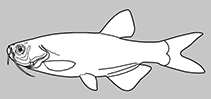
Radios blandos dorsales (total) : 9 - 10; Radios blandos anales: 14 - 15; Vértebra: 35 - 36. For field identification purposes, it is easily distinguished from all species of Devario by its color pattern including a wide light horizontal band along the middle of the side bordering a wide dark lateral band along the abdominal side, and the long rostral and maxillary barbels (Ref. 84468).
Occurs in a small, high-altitude stream with a cascade and riffle-pool habitat and with width of 2.27 m and at depth at most about 30 cm (Ref. 84468).
Ciclo vital y comportamiento de apareamiento
Madurez | Reproducción | Puesta | Huevos | Fecundidad | Larva
Pramod, P.K., F. Fang, K. Rema Devi, Liao-T.-Y., T.J. Indra, K.S. Jameela Beevi and S.O. Kullander, 2010. Betadevario ramachandrani, a new danionine genus and species from the Western Ghats of India (Teleostei: Cyprinidae: Danioninae). Zootaxa 2519:31-47. (Ref. 84468)
Situación en la Lista Roja de la UICN (Ref. 130435: Version 2025-2 (Global))
Amenaza para el ser humano
Harmless
Usos humanos
Herramientas
Informes especiales
Descargar XML
Fuentes de Internet
Estimaciones basadas en modelos
Índice de diversidad filogenética (Referencia
82804): PD
50 = 1.0000 [Uniqueness, from 0.5 = low to 2.0 = high].
Bayesian length-weight: a=0.00589 (0.00244 - 0.01420), b=3.12 (2.91 - 3.33), in cm total length, based on LWR estimates for this (Sub)family-body shape (Ref.
93245).
Nivel trófico (Referencia
69278): 3.1 ±0.3 se; based on size and trophs of closest relatives
Vulnerabilidad pesquera (Ref.
59153): Low vulnerability (10 of 100).
🛈