Taxonomic Remarks
This species is synonym of Salmo marmoratus Cuvier, 1829 in Eschmeyer (CofF ver. Jan. 2012: Ref. 89336).
Milieu: milieu / Klimaatzone / Diepte / verspreidingsgebied
Ecologie
; zoet water benthopelagisch. Subtropical
Europe: Po to Soca drainages (where it is possibly introduced) and northern slope of Apennine range (Italy, Switzerland, Slovenia). The western and eastern distributional limits are not clear.
Grootte / Gewicht / Leeftijd
Maturiteit: Lm ? range ? - ? cm
Max length : 80.0 cm SL mannelijk / geslacht onbekend; (Ref. 59043); common length : 40.0 cm SL mannelijk / geslacht onbekend; (Ref. 59043); max. gerapporteerde leeftijd: 8 Jaren (Ref. 59043)
Korte beschrijving
Determinatiesleutels | Morfologie | Morfometrie
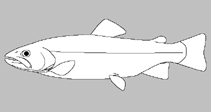
Distinguished from congeners in Apennine Peninsula by the combination of the following characters: parr marks absent in adults and subadults (over about 10 cm SL); parr marks vertically elongated; caudal fin slightly emarginate; body pattern not marbled; red spots not restricted to lateral line; black or dark brown spots present. This diagnosis is tentative as genetic data indicate that Salmo cenerinus represents a lineage very different from those of Atlantic and Black Sea basins, but there is no published morphological comparison. Salmo trutta has probably hybridized with most native populations (Ref. 59043).
Body shape (shape guide): fusiform / normal.
Inhabits streams in hilly areas, with clear, flowing and well oxygenated water (as a result of continuous stocking, often present in unsuitable habitats). Also occurs in alpine and subalpine lakes. Feeds on aquatic insects and invertebrates. Large individuals also prey on fishes. Moves to smaller tributaries to spawn on gravel. Attains a maximum size of up to about 80 cm SL and lives up to at least 8 years. Introduced and has hybridized with Salmo marmoratus (Ref. 59043).
Levenscyclus en paargedrag
Maturiteit | Voortplanting | Paaien | Eieren | Fecunditeit | Larven
Kottelat, M. and J. Freyhof, 2007. Handbook of European freshwater fishes. Publications Kottelat, Cornol and Freyhof, Berlin. 646 pp. (Ref. 59043)
Status op de Rode Lijst van het IUCN (Ref. 130435: Version 2025-2 (Global))
Gevaar voor de mens
Harmless
Gebruik door de mens
Visserij: van potentieel belang
Tools
Speciale rapporten
Download XML
Internetbronnen
Schattingen op basis van modellen
Fylogenetische diversiteitsindex (Ref.
82804): PD
50 = 0.5000 [Uniqueness, from 0.5 = low to 2.0 = high].
Bayesian length-weight: a=0.01047 (0.00486 - 0.02255), b=3.03 (2.86 - 3.20), in cm total length, based on LWR estimates for this Genus-body shape (Ref.
93245).
Trofisch niveau (Ref.
69278): 3.7 ±0.5 se; based on size and trophs of closest relatives
Weerstandsvermogen (Ref.
120179): Gemiddeld, minimale populatieverdubbelingstijd 1,4-4,4 jaar (tm=2-3).
Kwetsbaarheid van de visserij (Ref.
59153): High vulnerability (59 of 100).
🛈