Oxymonacanthus longirostris, Harlequin filefish : aquarium

You can sponsor this page

Oxymonacanthus longirostris (Bloch & Schneider, 1801)

Harlequin filefish
Añada su observación en Fish Watcher
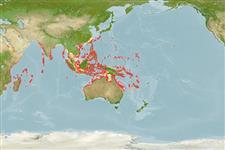
Native range
This map was computer-generated and has not yet been reviewed.
Oxymonacanthus longirostris   AquaMaps   Data sources: GBIF OBIS
Sube tu fotos y Vídeos
Imágenes | Vídeos | Sellos, monedas, varios | Google image
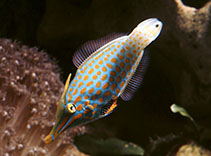
Image of Oxymonacanthus longirostris (Harlequin filefish)
Oxymonacanthus longirostris
Foto de Muséum-Aquarium de Nancy/D. Terver

Clasificación / Nombres Nombres comunes | Sinónimos | Catalog of Fishes(Género, Especie) | ITIS | CoL | WoRMS | Cloffa

> Tetraodontiformes (Puffers and filefishes) > Monacanthidae (Filefishes)
Etymology: Oxymonacanthus: Greek, oxys = sharp + Greek, monos = one + Greek, akantha = thorn (Ref. 45335).
More on authors: Bloch & Schneider.

Entorno: milieu / zona climática / rango de profundidad / gama de distribución Ecología

marino asociado a arrecife; no migratorio (Ref. 52884); rango de profundidad 1 - 35 m (Ref. 90102). Tropical; 30°N - 24°S, 114°E - 171°E

Distribución Territorios | Áreas FAO | Ecosistemas | Ocurrencias, apariciones | Mapa de puntos | Introducciones | Faunafri

Indo-Pacific: East Africa south to Maputo, Mozambique (Ref. 4421) and east to Samoa, north to Ryukyu Islands, south to the southern Great Barrier Reef, New Caledonia, and Tonga. Replaced by Oxymonacanthus halli in the Red Sea.

Tamaño / Peso / Edad

Madurez: Lm ?  range ? - ? cm
Max length : 12.0 cm TL macho / no sexado; (Ref. 9710)

Descripción breve Claves de identificación | Morfología | Morfometría

Espinas dorsales (total) : 2; Radios blandos dorsales (total) : 31 - 35; Espinas anales: 0; Radios blandos anales: 29 - 32. Ventral rudiment absent; bristles on caudal peduncle of males longer than others on body (Ref. 37816).
Body shape (shape guide): short and / or deep.

Biología     Glosario (por ej. epibenthic)

Adults occur in clear lagoon and seaward reefs from 0.5 to at least 30 m. They go around in pairs or small groups and nest near bases of dead corals, often on clumps of algae. Monogamous (Ref. 52884, 48637). They feed exclusively on Acropora polyps. Feeding takes place throughout the day becoming less towards the evening (Ref. 46144).

Ciclo vital y comportamiento de apareamiento Madurez | Reproducción | Puesta | Huevos | Fecundidad | Larva

Aggression is used commonly in courtship. Spawning commences when after swimming together in different tufts, the female concentrates on just one and begins to thrust repeatedly and pause. The male follows suit nuzzling the female. The female then drops into the algae and spawns, while the male releases the sperm beside her. The pair then swims back to their territory (Ref. 46144). Monogamous mating is observed as both facultative and social (Ref. 52884).

Referencia principal Suba sus referencias | Referencias | Coordinador : Hutchins, Barry | Colaboradores

Myers, R.F., 1991. Micronesian reef fishes. Second Ed. Coral Graphics, Barrigada, Guam. 298 p. (Ref. 1602)

Situación en la Lista Roja de la UICN (Ref. 130435: Version 2025-2 (Global))

  Vulnerable (VU) (A3c); Date assessed: 05 July 2015

CITES

Not Evaluated

CMS (Ref. 116361)

Not Evaluated

Amenaza para el ser humano

  Harmless


Usos humanos

Pesquerías: sin interés; Acuario: Comercial
FAO - Publication: search | FishSource | Sea Around Us

Más información

Ecología Trófica
Alimentos (presas)
Composición de la dieta
consumo de alimento
Raciones de comida
Despredadores
Ecología
Ecología
Dinámica de la población
Coeficiente del crecimiento para
Edades / tallas máximas
Longitud-peso rel.
Longitud-longitud rel.
Longitud-frecuencias
Conversión de masas
Reclutamiento
Abundancia
Ciclo de vida
Reproducción
Madurez
Madurez/Gills rel.
Fecundidad
Puesta
Agregaciones de desove
Huevos
Desarrollo de los huevos
Larva
Dinámica larvaria
Distribución
Territorios
Áreas FAO
Ecosistemas
Ocurrencias, apariciones
Introducciones
BRUVS - Vídeos
Anatomía
Superficie branquial
Cerebro
Otolito
Fisiología
Composición corporal
Nutrientes
Consumo del oxígeno
Tipo de natación
Velocidad de natación
Pigmentos visuales
Sonido de peces
Enfermedades y parásitos
Toxicidad (CL50)
Genética
Genoma
Genética
Heterocigosidad
heritabilidad
Diversidad genética
Relacionados con el ser humano
Sistemas de acuicultura
Perfiles de acuicultura
Razas
Ciguatera cases
Sellos, monedas, varios
Divulgación
Colaboradores
Referencias
Referencias

Herramientas

Informes especiales

Descargar XML

Fuentes de Internet

Estimaciones basadas en modelos

Temperatura preferida (Referencia 123201): 25 - 29.3, mean 28.4 °C (based on 2439 cells).
Índice de diversidad filogenética (Referencia 82804):  PD50 = 0.7500   [Uniqueness, from 0.5 = low to 2.0 = high].
Bayesian length-weight: a=0.01905 (0.00905 - 0.04012), b=2.93 (2.75 - 3.11), in cm total length, based on LWR estimates for this (Sub)family-body shape (Ref. 93245).
Nivel trófico (Referencia 69278):  3.3   ±0.6 se; based on diet studies.
Resiliencia (Referencia 120179):  Medio, población duplicada en un tiempo mínimo de 1.4-4.4 años (Fec = 200).
Vulnerabilidad pesquera (Ref. 59153):  Low vulnerability (10 of 100). 🛈
Nutrientes (Ref. 124155):  Calcium = 79.6 [34.6, 217.9] mg/100g; Iron = 0.822 [0.365, 1.964] mg/100g; Protein = 18.1 [15.8, 20.3] %; Omega3 = 0.121 [0.056, 0.249] g/100g; Selenium = 28.3 [13.4, 65.1] μg/100g; VitaminA = 79.6 [22.6, 288.7] μg/100g; Zinc = 1.51 [0.97, 2.44] mg/100g (wet weight);