Ταξινόμηση / Ονόματα
Κοινά ονόματα | Συνώνυμα | Catalog of Fishes(Γένος, Είδη) | ITIS | CoL | WoRMS | Cloffa
>
Cyprinodontiformes (Rivulines, killifishes and live bearers) >
Rivulidae (Rivulines) > Cynolebiinae
Etymology: Cynolebias: Greek, kyon = dog + Greek, odous = teeth + Greek, lebias = a kind of small fish (Ref. 45335); parnaibensis: Named for its unique occurrence in the Parnaíba River basin.
More on authors: Costa, Ramos, Alexandre & Ramos.
Περιβάλλον: περιβάλλον / κλιματική ζώνη / εύρος βάθους / εύρος διανομής
Οικολογία
; Γλυκού νερού Πελαγικό(ά); εύρος βάθους 0 - 1 m (Ref. 84460). Tropical; 8°S - 9°S, 41°W - 42°W
South America: Brazil.
Μέγεθος / Βάρος / Ηλικία
Γεννητική Ωρίμανση: Lm ? range ? - ? cm
Max length : 5.5 cm SL αρσενικό/απροσδιόριστο; (Ref. 84460)
Σύντομη περιγραφή
Κλείδες προσδιορισμού | Μορφολογία | Μορφομετρία
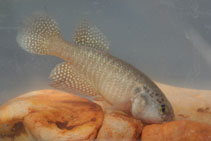
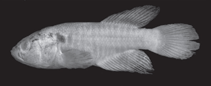
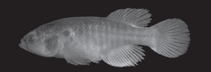
Cynolebias parnaibensis is distinguished from all other species of the genus, except C. griseus and C. gilbertoi, by having 27-31 neuromasts around eye (vs. 33-46). The new species differs from C. griseus by having 29-33 supraorbital neuromasts (vs. 19-22), 16-18 dorsal-fin rays and 19 anal-fin rays in males (vs. 20-22 and 21-23, respectively), 28-31 caudalfin rays (vs. 33-34), 6 pelvic-fin rays (vs. 5), dorsal-fin origin at a vertical between the base of the 4th or 6th anal-fin ray (vs. base of 1st or 2nd ray), 33-36 scales in the longitudinal series (vs. 29-31), 3+10 gill-rakers in the first branchial arch (vs. 5+15), absence of second pharyngobranchial teeth (vs. presence), absence of the ventral uncinate process of the second epibranchial (vs. presence), absence of the ventral limb of the posttemporal (vs. presence), and absence of contact organs on the flank scales in both sexes (vs. presence in males). From C. gilbertoi it differs by having 34-35 vertebrae (vs. 32-33), and by the absence of teeth on vomer (vs. 13-15 vomerine teeth). Cynolebias parnaibensis is also distinguished from C. griseus, C. gilbertoi, C. microphthalmus sverse series of scales on the anal-fin base (vs. absence) (Ref. 84460).
The type locality of this species is inserted in the Caatinga domain, a semi-arid phytogeographic formation, typical of northeastern Brazil; the lagoon is within the Canindé River drainage, which is part of the Parnaíba River basin. It was about 60 m long, 15 m wide, maximum depth 1 m, average depth 50 cm; water is turbid, light brown, and the bottom was sandy-muddy; emerging aquatic vegetation in moderate amount, scattered over the lagoon surface, while large amount of submerged vegetation was found, the predominant species of the family Hydrocharitaceae. Margins of the pond were in part densely covered by bushes and low vegetation (Ref. 84460).
Κύκλος ζωής και συμπεριφορά ζευγαρώματος
Γεννητική Ωρίμανση | Αναπαραγωγή | Γεννοβολία | Αβγά | Γονιμότητα | Προνύμφες
Costa, W.J.E.M., T.P.A. Ramos, Alexandre L.C. and R.T.C. Ramos, 2010. Cynolebias parnaibensis, a new seasonal killifish from the Caatinga, Parnaíba River basin, northeastern Brazil, with notes on sound producing courtship behavior (Cyprinodontiformes: Rivulidae). Neotrop. Ichthyol. 8(2):283-288. (Ref. 84460)
Κατάσταση Κόκκινου Καταλόγου IUCN (Ref. 130435: Version 2025-2 (Global))
Απειλή για τον άνθρωπο
Harmless
Ανθρώπινες χρήσεις
αλιεία: χωρίς ενδιαφέρον
Εργαλεία
Ειδικές εκθέσεις
Λήψη XML
Διαδικτυακές πηγές
Εκτιμήσεις βάσει μοντέλων
Δείκτης φυλογενετικής ποικιλότητας (Αναφ.
82804): PD
50 = 0.5000 [Uniqueness, from 0.5 = low to 2.0 = high].
Bayesian length-weight: a=0.01122 (0.00514 - 0.02450), b=3.04 (2.87 - 3.21), in cm total length, based on all LWR estimates for this body shape (Ref.
93245).
Τροφικό Επίπεδο (Αναφ.
69278): 3.2 ±0.4 se; based on size and trophs of closest relatives
Ευπάθεια στην αλιεία (Ref.
59153): Low vulnerability (10 of 100).
🛈