>
Scombriformes (Mackerels) >
Chiasmodontidae (Snaketooth fishes)
Etymology: Kali: Named after Kali, a Hindu goddess.
Eponymy: Kali, also known as Kālikā (‘the black one’) is a Hindu goddess, often depicted as having four arms. Dr Coenraad Kerbert (1849–1927) was a Dutch biologist who became Director (1890–1927) of the Amsterdam Zoo (Artis) and Chairman of the Dutch Committee for the Protection of Birds. [...] (Ref. 128868), visit book page.
More on author: Weber.
Ambiente: milieu / zona climática / intervalo de profundidade / gama de distribuição
Ecologia
marinhas batipelágico; intervalo de profundidade 200 - 4465 m (Ref. 75596), usually 800 - 2500 m (Ref. 75596). Deep-water
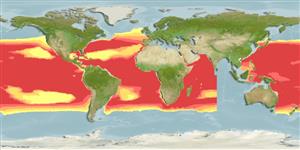
Circumglobal: equatorial, tropical, and subtropical regions, in the Atlantic from 38° N
to 21° S; a single record in the western Indian at 8° S, 31° S; in the Pacific 27° N to 33° S.
Tamanho / Peso / Idade
Maturidade: Lm ? range ? - ? cm
Max length : 20.0 cm SL macho/indeterminado; (Ref. 137577)
Descrição breve
Chaves de identificação | Morfologia | Morfometria
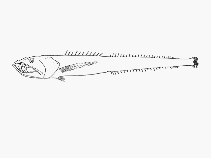
This species can be distinguished from its congeners except K. macrodon by the ascending process of premaxilla with a strong concavity limited anteriorly by bony crest (vs. ascending process of premaxilla flat or with gentle concavity, anterior bony crest absent). It further differs from K. colubrina, K. falx, K. indica, and K. parri by the teeth in lateral series of premaxilla and dentary 12-25, type 4, needle-like (vs. teeth in lateral series of premaxilla with ventral attachment, recurved in parri; 5-11, caniniform, type 4, slightly curved in indica and falx and recurved in colubrina); from K. macrura, teeth in lateral series of premaxilla and dentary type 4, needle-like, extending to the end of dentigerous area, teeth with ventral attachment absent in lateral series (vs. teeth in lateral series of premaxilla and dentary need-like in anterior third and fourth, respectively, followed by teeth with ventral attachment, recurved in posterior areas). It is distinguished from K, macrodon by the teeth in mesial series of premaxilla and dentary, 4-5, modally 5 (vs. teeth in mesial series of premaxilla teeth 6-9, modally 7, of and dentary 7-9, modally 8) (Ref. 75596).
Body shape (shape guide): elongated.
Most adults have been taken in hauls in depths exceeding 1,000 m but a number of adults have been taken in hauls in depths between 500 to 1,000 m (Ref. 6944).
Ciclo de vida e comportamento de acasalamento
Maturidade | Reprodução | Desova | Ovos | Fecundidade | Larvas
Melo, M.R.S., 2008. The genus Kali Lloyd (Chiasmodontidae: Teleostei) with description of new two species, and the revalidation of K. kerberti Weber. Zootaxa 1747:1-33. (Ref. 75596)
Categoria na Lista Vermelha da IUCN (Ref. 130435: Version 2025-2 (Global))
Ameaça para o homem
Harmless
Utilização humana
Ferramentas
Relatórios especiais
Descarregue XML
Fontes da internet
Estimativas baseadas em modelos
Temperatura preferida (Ref.
123201): 1.9 - 5.7, mean 3 °C (based on 4257 cells).
Índice de diversidade filogenética (Ref.
82804): PD
50 = 0.5078 [Uniqueness, from 0.5 = low to 2.0 = high].
Bayesian length-weight: a=0.00389 (0.00180 - 0.00842), b=3.12 (2.94 - 3.30), in cm total length, based on all LWR estimates for this body shape (Ref.
93245).
Nível Trófico (Ref.
69278): 3.8 ±0.2 se; based on size and trophs of closest relatives
Resiliência (Ref.
120179): Médio, tempo mínimo de duplicação da população 1,4 - 4,4 anos (K=0.67).
Vulnerabilidade da pesca (Ref.
59153): Low vulnerability (14 of 100).
🛈