>
Eupercaria/misc (Various families in series Eupercaria) >
Sparidae (Porgies)
Etymology: Acanthopagrus: Greek, akantha = thorn + Greek, pagros, a kind of fish (Ref. 45335).
More on author: Peters.
Environnement : milieu / zone climatique / profondeur / gamme de distribution
Écologie
marin; eau douce; saumâtre démersal. Tropical
Africa: western Indian Ocean from Knysna in South Africa to southern Mozambique (Ref. 83673). Also known from Zambezi River and some other coastal rivers (Ref. 57418, 83673). Possibly present in Madagascar, but this needs confirmation (Ref. 83673).
Taille / Poids / Âge
Maturité: Lm ? range ? - ? cm
Max length : 60.0 cm SL mâle / non sexé; (Ref. 58304)
Description synthétique
Clés d'identification | Morphologie | Morphométrie
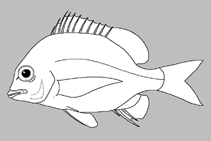
Épines dorsales (Total) : 11; Rayons mous dorsaux (Total) : 10 - 12; Épines anales: 3; Rayons mous anaux: 8. Diagnosis: This species is distinguished from its congeners of by the following characters: 3.5 scale rows between fifth dorsal-fin spine base and lateral line; front edge of dorsal scaly area on head (dorsal view) with a median W-shaped scaleless area and with small scales present just before an oblique temporal row of larger scales; 44-46 pored lateral-line scales; second anal-fin spine (2AS) slightly longer than third anal fin spine (3AS), ratio 2AS/3AS 5 1.15-1.45 (mean 1.25); ventral edge of first two infraorbitals straight in specimens less than 23 cm SL, weakly concave in specimens more than 25 cm standard length; preopercle flange with 0-6 scales, number increasing with growth and is obvious in specimens over 20 cm standard length ; black streaks near anal-fin base on interradial membranes between rays; both jaws with well developed molariform teeth (Ref. 83673).
Body shape (shape guide): short and / or deep.
Adults and juveniles found in estuaries and in freshwater (Ref. 58304).
Cycle de vie et comportement reproducteur
Maturité | Reproduction | Frai | Œufs | Fécondité | Larves
Iwatsuki, Y. and P.C. Heemstra, 2010. Taxonomic review of the Western Indian Ocean species of the genus Acanthopagrus Peters, 1855 (Perciformes: Sparidae), with description of a new species from Oman. Copeia 2010(1):123-136. (Ref. 83673)
Statut dans la liste rouge de l'IUCN (Ref. 130435: Version 2025-2 (Global))
Menace pour l'homme
Harmless
Utilisations par l'homme
Pêcheries: commercial
Outils
Articles particuliers
Télécharger en XML
Sources Internet
Estimations basées sur des modèles
Indice de diversité phylogénétique (Réf.
82804): PD
50 = 0.5000 [Uniqueness, from 0.5 = low to 2.0 = high].
Bayesian length-weight: a=0.01995 (0.00886 - 0.04496), b=2.97 (2.80 - 3.14), in cm total length, based on LWR estimates for this Genus-body shape (Ref.
93245).
Niveau trophique (Réf.
69278): 3.5 ±0.5 se; based on size and trophs of closest relatives
Résilience (Réf.
120179): Faible, temps minimum de doublement de population : 4,5 à 14 années (Preliminary K or Fecundity.).
Vulnérabilité de la pêche (Ref.
59153): Moderate to high vulnerability (49 of 100).
🛈