Clasificación / Nombres
Nombres comunes | Sinónimos | Catalog of Fishes(Género, Especie) | ITIS | CoL | WoRMS | Cloffa
>
Beloniformes (Needle fishes) >
Adrianichthyidae (Ricefishes) > Oryziinae
Etymology: Oryzias: Greek, oryza = rice; because of the habitat used by this fish (Ref. 45335).
Eponymy: Dr Daisy Wowor (d: 1956) is an evolutionary biologist and systematic carcinologist. [...] (Ref. 128868), visit book page.
Entorno: milieu / zona climática / rango de profundidad / gama de distribución
Ecología
; agua dulce pelágico; pH range: 6.0 - 7.0. Tropical; 5°S - 6°S, 122°E - 123°E
Asia: Indonesia. The single known collection of O. woworae was from the type locality Sulawesi Tenggara, Muna Island, Regency of Muna, District Parigi, Village Wakumoro, Mata air Fotuno (Ref. 84259).
Tamaño / Peso / Edad
Madurez: Lm ? range ? - ? cm
Max length : 2.8 cm SL macho / no sexado; (Ref. 84259)
Descripción breve
Claves de identificación | Morfología | Morfometría
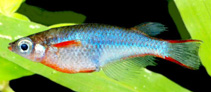
Oryzias woworae is distinguished from all other ricefishes by an autapomorphic color pattern of both sexes in life: the ventral surface of head and body anterior to pelvic fins, dorsal portion of pectoral fins, dorsal-fin base, posterior portion of anal-fin base, caudal peduncle, and dorsal and ventral portions of caudal fin are brilliant red; the midlateral scales from just posterior to the eye to the caudal-fin base and the body scales anterior to the anal fin and below midlateral scales are steel blue. The operculum and base of the pectoral fin are silvery. Oryzias woworae has a truncate, rather than lunate or emarginate, caudal fin that distinguishes it from the large, pelagic Sulawesi ricefish in the genus Adrianichthys and five species of Oryzias: O. bonneorum, O. nebulosus, O. nigrimas, O. orthognathus, and O. sarasinorum. Oryzias woworae is readily distinguished from other Oryzias with a truncate caudal fin by an hour-glass shaped, rather than rounded, ossified portion of the mesethmoid with no cartilage on its midlateral margins, like the ethmoid of some of the larger, pelagic Sulawesi ricefishes (Ref. 84259).
Body shape (shape guide): elongated.
Ciclo vital y comportamiento de apareamiento
Madurez | Reproducción | Puesta | Huevos | Fecundidad | Larva
Parenti, L.R. and R.K. Hadiaty, 2010. A new, remarkably colorful, small ricefish of the genus Oryzias (Beloniformes, Adrianichthyidae) from Sulawesi, Indonesia. Copeia 2010(2):268-273. (Ref. 84259)
Situación en la Lista Roja de la UICN (Ref. 130435: Version 2025-2 (Global))
Amenaza para el ser humano
Harmless
Usos humanos
Pesquerías: sin interés
Herramientas
Informes especiales
Descargar XML
Fuentes de Internet
Estimaciones basadas en modelos
Índice de diversidad filogenética (Referencia
82804): PD
50 = 0.5000 [Uniqueness, from 0.5 = low to 2.0 = high].
Bayesian length-weight: a=0.00479 (0.00190 - 0.01207), b=3.13 (2.91 - 3.35), in cm total length, based on LWR estimates for this (Sub)family-body shape (Ref.
93245).
Nivel trófico (Referencia
69278): 3.2 ±0.4 se; based on size and trophs of closest relatives
Vulnerabilidad pesquera (Ref.
59153): Low vulnerability (10 of 100).
🛈