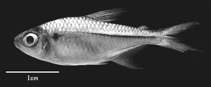
Classification / Noms
Noms communs | Synonymes | Catalog of Fishes(Genre, Espèce) | ITIS | CoL | WoRMS | Cloffa
>
Characiformes (Characins) >
Acestrorhamphidae (American tetras) > Hyphessobryconinae
Etymology: Hyphessobrycon: Greek, hyphesson, -on, -on = a little smaller + Greek, bryko = to bite (Ref. 45335); taguae: Named for La Tagua creek, near Puerto Leguizamo, Putumayo, its type locality.
Environnement : milieu / zone climatique / profondeur / gamme de distribution
Écologie
; eau douce pélagique. Tropical
South America: Colombia.
Taille / Poids / Âge
Maturité: Lm ? range ? - ? cm
Max length : 3.1 cm SL mâle / non sexé; (Ref. 84248)
Description synthétique
Clés d'identification | Morphologie | Morphométrie
Rayons mous dorsaux (Total) : 9; Rayons mous anaux: 18 - 20; Vertèbres: 33 - 34. This species is distinguished from other members of its species group by the following characters: 5-6 pored lateral-line scales (vs. 7-23), conical maxillary teeth (vs. maxillary teeth tri- or multicuspid); 5 infraorbitals (vs. 6 except in H. heterorhabdus and H. amaronensis with 5); mean body depth 29.65 % SL (vs. 35.71-42.12%; except in H. heterorhabdus with mean body depth 30.39 and H. diancistrus with 23.70); mean upper jaw length 18.94% SL (vs. 22.70-30.51%; except H. amaronensis with 15.66%); presence of a red band above the dark lateral band (vs. without band); males with hooks on all fins (vs. spines not on all fins) (Ref. 84248).
Found over organic detritus and decomposing vegetation, apparent water color was brown to black, low dissolved oxygen (0.42-0.75 mg/l), as was conductivity (42-43 μs) and oxygen saturation (5.3-10 %), slightly acidic pH (6.0-6.2). Two of the five stomachs of cleared and stained specimens contain insects (100 %N, 85. 71%V) and unidentified digested material (14.28%V) (Ref. 84248).
Cycle de vie et comportement reproducteur
Maturité | Reproduction | Frai | Œufs | Fécondité | Larves
García-Alzate, C.A., C. Román-Valencia and D.C. Taphorn, 2008. Two new species of Hyphessobrycon (Pisces: Characiformes: Characidae) from Putumayo River, with keys to the Colombian Hyphessobrycon heterorhabdus-group species. Brenesia 70:33-46. (Ref. 84248)
Statut dans la liste rouge de l'IUCN (Ref. 130435: Version 2025-2 (Global))
Menace pour l'homme
Harmless
Utilisations par l'homme
Outils
Articles particuliers
Télécharger en XML
Sources Internet
Estimations basées sur des modèles
Indice de diversité phylogénétique (Réf.
82804): PD
50 = 0.5000 [Uniqueness, from 0.5 = low to 2.0 = high].
Bayesian length-weight: a=0.01202 (0.00479 - 0.03019), b=3.09 (2.90 - 3.28), in cm total length, based on LWR estimates for this Genus-body shape (Ref.
93245).
Niveau trophique (Réf.
69278): 2.9 ±0.3 se; based on size and trophs of closest relatives
Vulnérabilité de la pêche (Ref.
59153): Low vulnerability (10 of 100).
🛈