Classificazione / Nomi
Nomi Comuni | Sinonimi | Catalog of Fishes(Genere, Specie) | ITIS | CoL | WoRMS | Cloffa
>
Eupercaria/misc (Various families in series Eupercaria) >
Lethrinidae (Emperors or scavengers) > Monotaxinae
Etymology: Gymnocranius: Greek, gymnos = naked + Greek, kranion = skull (Ref. 45335).
Ambiente: milieu / zona climatica / distribuzione batimetrica / gamma di distribuzione
Ecologia
marino benthopelagico; distribuzione batimetrica 10 - 35 m (Ref. 101097). Subtropical; 22°S - 23°S, 166°E - 167°E
Pacific Ocean: New Caledonia (Ref. 84158).
Dimensione / Peso / Età
Maturità: Lm ? range ? - ? cm
Max length : 35.8 cm SL maschio/sesso non determinato; (Ref. 84158)
Breve descrizione
Chiavi di identificazione | Morfologia | Morfometria
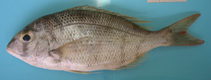
A species of Lethrinidae with the following combination of characters: four rows of scales on cheek; 10 soft rays in dorsal fin; ten soft rays in anal fin; body oblong (hence the species epithet) and fusiform, ratio of standard length to body depth between 2.6 and 2.8, increasing with size; dorsal and ventral profiles almost similarly convex; tip of snout only slightly below axis of body; snout slightly rounded; tail elongated with rounded tips; posterior part of jaws reaching to about level of nostril; pored scales on lateral line: 48; scales between middle portion of spinous dorsal fin and lateral line: six. Lower edge of eye slightly (in the smaller individuals examined) to well above a line from tip of snout to middle of caudal fin fork; horizontal or sub-horizontal wavy blue lines or dashes on lower part of snout and on cheeks; pale blue speckles more or less visible on operculum. The lines or dashes become dark red or brown against paler background in preserved specimens; they do not extend up to the upper part of snout and their number slightly increases with size. Forehead, snout and upper lip of fresh specimens can be bright yellow, matched by similar yellow colouration of margin of operculum; loosely defined vertical dark bar crossing the eye; on fresh animals, dorsal, pectoral, anal and caudal fins drab, brownish or yellowish, with reddish to vermilion edges. Each lower jaw has a raw of three small, slender canines on each side of one large canine at front, and a lateral row of eight to 10 conical teeth; numerous villiform teeth form a brush behind the front canines; each upper jaw has a front row of six to 10 small, slender canines followed by four to five conical teeth and a patch of villiform teeth.
Ciclo vitale e comportamento di accoppiamento
Maturità | Riproduzione | Deposizione | Uova | Fecondità | Larve
Borsa, P., P. Béarez and W.-J. Chen, 2010. Gymnocranius oblongus, a new large-eye bream species from New Caledonia (Teleostei: Lethrinidae). C. R. Biologies 333:241-247. (Ref. 84158)
Stato della Lista Rossa IUCN (Ref. 130435: Version 2025-2 (Global))
Minaccia per l'uomo
Harmless
Usi umani
Strumenti
Rapporti speciali
Scarica XML
Fonti Internet
Stime basate su modelli
Indice di diversità filogenetica (Fonte Biblio.
82804): PD
50 = 0.5005 [Uniqueness, from 0.5 = low to 2.0 = high].
Bayesian length-weight: a=0.01698 (0.00720 - 0.04003), b=2.98 (2.79 - 3.17), in cm total length, based on LWR estimates for this (Sub)family-body shape (Ref.
93245).
Livello trofico (Fonte Biblio.
69278): 3.4 ±0.6 se; based on size and trophs of closest relatives
Resilienza (Fonte Biblio.
120179): Medio, tempo minimo di raddoppiamento della popolazione 1.4 - 4.4 anni (Preliminary K or Fecundity.).
Vulnerabilità della pesca (Ref.
59153): Low to moderate vulnerability (34 of 100).
🛈