>
Cyprinodontiformes (Rivulines, killifishes and live bearers) >
Poeciliidae (Poeciliids) > Poeciliinae
Etymology: Gambusia: Gambusia: From the Cuban term, Gambusino, which means "nothing", usually in the context of a joke or a farce. Fishing for gambusinos = when one catches nothing (Ref. 45335); zarskei: Named after Dr. Axel Zarske in recognition of his valuable contributions to discussions on the conservation biology and problems of endangered fishes such as G. zarskei (Ref. 84135).
Eponymy: Dr Axel Zarske (d: 1952) is a German ichthyologist who is a section head in the ichthyology department of Senckenberg Natural History Museum. [...] (Ref. 128868), visit book page.
Ambiente: milieu / zona climática / intervalo de profundidade / gama de distribuição
Ecologia
; Água doce pelágico(a,os,as); pH range: 7.9 - ?. Subtropical; 24°C - 26°C (Ref. 84135); 29°N - 28°N, 105°W - 106°W
North America: Mexico. Only known from the upper Rio Conchos system in the Sierra San Diego area, east of San Diego de Alcalá, Chihuahua, Mexico (Ref. 84135).
Tamanho / Peso / Idade
Maturidade: Lm ? range ? - ? cm
Max length : 2.3 cm SL macho/indeterminado; (Ref. 84135); 2.9 cm SL (female)
Descrição breve
Chaves de identificação | Morfologia | Morfometria
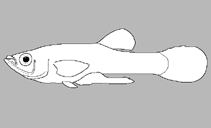
Vértebras: 30 - 31. Gambusia zarskei is a small sized species of the subgenus Arthrophallus (SL in males usually not exceeding 25 mm and in females 35 mm), which is distinguished from all other species of the senilis species group by the following characters: shafts of distal spines of gonopodium ray 3 much prolonged, lateral projection on elbow weekly developed, vs. well developed in G. amistadensis and G. hurtadoi or absent in G. alvarezi, G. gaigei and G. senilis. G. zarskei is also distinguished by the following unique combination of characters: relative gonopodial ray 4p serra length of gonopodium long; frequency distribution of SEL/SEW radius 1.35 – 1.65, vs. 0.95 – 1.25 in G. alvarezi, 1.55 – 1.90 in G. amistadensis, 1.00 – 1.35 in G. gaigei and 0.75 – 1.05 in G. hurtadoi; elbow on gonopodium ray 4a simple and not rounded or distally hooked, vs. usually hooked in G. alvarezi, G. gaigei, G. senilis; 8 dorsal fi n rays, vs. usually 9 in G. alvarezi and G. hurtadoi; black anal spot present vs. absent in G. senilis.
Ciclo de vida e comportamento de acasalamento
Maturidade | Reprodução | Desova | Ovos | Fecundidade | Larvas
Meyer, M.K., S. Schories and M. Schartl, 2010. Description of Gambusia zarskei sp. n. - a new poeciliid fish from the upper Rio Conchos system, Chihuahua, Mexico (Teleostei: Cyprinodontiformes: Poeciliidae). Verteb. Zool. 60(1):11-18. (Ref. 84135)
Categoria na Lista Vermelha da IUCN (Ref. 130435: Version 2025-2 (Global))
Ameaça para o homem
Harmless
Utilização humana
Ferramentas
Relatórios especiais
Descarregue XML
Fontes da internet
Estimativas baseadas em modelos
Índice de diversidade filogenética (Ref.
82804): PD
50 = 0.5000 [Uniqueness, from 0.5 = low to 2.0 = high].
Bayesian length-weight: a=0.00851 (0.00369 - 0.01962), b=3.15 (2.96 - 3.34), in cm total length, based on LWR estimates for this (Sub)family-body shape (Ref.
93245).
Nível Trófico (Ref.
69278): 3.1 ±0.4 se; based on size and trophs of closest relatives
Resiliência (Ref.
120179): Elevada, tempo mínimo de duplicação da população menor que 15 meses (Preliminary K or Fecundity.).
Vulnerabilidade da pesca (Ref.
59153): Low vulnerability (10 of 100).
🛈