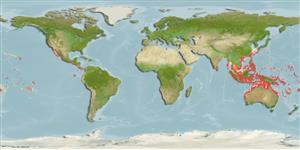
Ambiente: milieu / zona climatica / distribuzione batimetrica / gamma di distribuzione
Ecologia
marino associati a barriera corallina; non migratori; distribuzione batimetrica 4 - 55 m (Ref. 30874). Tropical; 32°N - 32°S
Western Pacific: Christmas Island in the eastern Indian Ocean to Fiji, north to southern Japan, south to Scott Reef (eastern Indian Ocean) and Lord Howe Island. Uncommon around oceanic islands (Ref. 9710).
Dimensione / Peso / Età
Maturità: Lm ? range ? - ? cm
Max length : 19.0 cm TL maschio/sesso non determinato; (Ref. 9710); Età massima riportata: 6 anni (Ref. 11318)
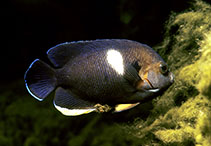
Spine dorsali (totale) : 14; Raggi dorsali molli (totale) : 15 - 16; Spine anali: 3; Raggi anali molli: 16 - 17. Overall black with an elongate vertical black blotch on the middle of the upper sides. When small, mainly black with a white bar; the white bar changes to a central blotch and varies greatly in shape and size (Ref. 48636). Dorsal and anal fins with submarginal blue line; most of the pelvic and the anterior portion of the anal fin yellow. Caudal fin with submarginal blue line (Ref. 1602). Body depth 1.8-2.0 in SL. Scales longitudinal series 45-48 (Ref. 90102).
Body shape (shape guide): short and / or deep; Cross section: compressed.
Relatively uncommon in mixed coral and rubble areas of lagoon and seaward reefs. The largest member of the genus (Ref. 1602). Feeds mainly on algae. Forms harems of 3-7 individuals. Frequently exported through the aquarium trade (Ref. 48391).
Ciclo vitale e comportamento di accoppiamento
Maturità | Riproduzione | Deposizione | Uova | Fecondità | Larve
Sex reversals are completed in 29-35 days (Ref. 34253).
Myers, R.F., 1991. Micronesian reef fishes. Second Ed. Coral Graphics, Barrigada, Guam. 298 p. (Ref. 1602)
Stato della Lista Rossa IUCN (Ref. 130435: Version 2025-2 (Global))
Minaccia per l'uomo
Harmless
Usi umani
Pesca: commerciale; Acquario: Commerciale
Strumenti
Rapporti speciali
Scarica XML
Fonti Internet
Stime basate su modelli
Temperatura preferita (Fonte Biblio.
123201): 24.5 - 29, mean 28.1 °C (based on 884 cells).
Indice di diversità filogenetica (Fonte Biblio.
82804): PD
50 = 0.5000 [Uniqueness, from 0.5 = low to 2.0 = high].
Bayesian length-weight: a=0.03548 (0.01964 - 0.06409), b=2.85 (2.70 - 3.00), in cm total length, based on LWR estimates for this species & (Sub)family-body (Ref.
93245).
Livello trofico (Fonte Biblio.
69278): 2.8 ±0.35 se; based on food items.
Resilienza (Fonte Biblio.
120179): Medio, tempo minimo di raddoppiamento della popolazione 1.4 - 4.4 anni (Preliminary K or Fecundity.).
Vulnerabilità della pesca (Ref.
59153): Low vulnerability (10 of 100).
🛈
Nutrienti (Ref.
124155): Calcium = 67.1 [34.1, 106.2] mg/100g; Iron = 0.602 [0.372, 0.980] mg/100g; Protein = 18.2 [17.0, 19.3] %; Omega3 = 0.109 [0.069, 0.172] g/100g; Selenium = 28.9 [16.3, 52.2] μg/100g; VitaminA = 83.2 [22.8, 285.7] μg/100g; Zinc = 1.48 [1.03, 2.10] mg/100g (wet weight);