التصنيف / الأسماء
الأسماء الشائعة | مرادفات | Catalog of Fishes(جنس, الانواع) | ITIS | CoL | WoRMS | Cloffa
>
Cypriniformes (Carps) >
Balitoridae (River loaches)
Etymology: eddsi: Named for D.R. Edds, who collected the type series, in recognition of his contribution to the knowledge of the fish fauna of Nepal (Ref. 84034).
Eponymy: Dr David Ray Edds (d: 1954) is an ichthyologist and aquatic ecologist. [...] (Ref. 128868), visit book page.
البيئة: الوسط / المنطقة المناخية / نطاق العمق / نطاق التوزيع
البيئة
; المياه العذبة القاع. Tropical; 29°N - 28°N, 81°E - 82°E
Asia: Nepal.
الحجم / وزن / العمر
النضج: Lm ? range ? - ? cm
Max length : 4.6 cm SL ذكر/ مختلط الجنس; (Ref. 84034)
وصف مختصر
مفاتيح التعريف | الوصف الخارجي | قياسات المظهر الخارجي
Distinguished from all congeners by its lower number of unbranched pectoral-fin rays (6-7 v. 8-12), by its shorter pelvic fins (12·8-14%LSv. 19-24) and by the absence of dark circular or irregular shaped dark blotches along the dorsal midline (v. presence of dark circular or irregular shaped dark blotches arranged in a longitudinal row along dorsal midline). Balitora eddsi is further distinguished from B. brucei by its posteriorly pointed (v. posteriorly rounded) median lobe between anterior rostral barbels and its pointed (v. rounded) snout, from B. brucei, B. burmanica, B. kwangsiensis, B. lancangjiangensis, B. meridionalis and B. nantingensis by its more posteriorly positioned dorsal fin (dorsal-fin origin posterior to pelvic-fin origin v. dorsal-fin origin opposite pelvic-fin origin in B. brucei, B. burmanica, B. lancangjiangensis and B. meridionalis or anterior to pelvic-fin origin in B. kwangsiensis and B. nantingensis), from B. burmanica, B. annamatica, B. meridionalis, B. mysorensis and B. nantingensis by its higher number of lateral-line scales (66-67 v. 62-65 in B. burmanica, 61-62 in B. annamatica, 62-64 in B. meridionalis, 64-65 in B. mysorensis, 59-64 in B. nantingensis) and from B. annamatica, B. meridionalis and B. mysorensis by its longer and more slender caudal peduncle (caudal peduncle length 22-23·2% LS, its depth 4·1-4·2 times its length v. caudal peduncle length 13-15% LS in B. annamatica, its depth 1·9-2·2 times its length; 14-16% LS in B. meridionalis, its depth 1·9-2·8 its length; caudal peduncle depth 1·9 times its length in B. mysorensis). It is further distinguished from B. longibarbata in having one barbel at each corner of the mouth (v. a pair of barbels at each corner of the mouth).
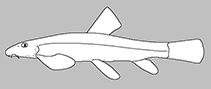
Body shape (shape guide): eel-like.
The species was collected during a rafting trip down the Gerwa River, but the precise collection sites of the type series cannot be pinpointed with any further accuracy. The rafting trip occurred between 1000 and 1700 hours, and collections were made with a cast-net
and 15 foot long straight seine (Ref. 84034).
دورة الحياة وسلوك التزاوج
النضج | التكاثر | وضع البيض | بيض | الخصوبة | اليرقات
Conway, K.W. and R.L. Mayden, 2010. Balitora eddsi, a new species of hillstream loach (Ostariophysi: Balitoridae) from Nepal. J. Fish Biol. 76(6):1466-1473. (Ref. 84034)
حالة القائمة الحمراء للاتحاد الدولي لحفظ الطبيعة والموارد الطبيعية (Ref. 130435: Version 2025-2 (Global))
استخدامات بشرية
أدوات
تقارير خاصة
تنزيل XML
مصادر علي الأنترنت
تقديرات تستند إلى النماذج
مؤشر التنوع الشُعبي الوراثي (مرجع
82804): PD
50 = 0.5000 [Uniqueness, from 0.5 = low to 2.0 = high].
Bayesian length-weight: a=0.00214 (0.00085 - 0.00539), b=3.09 (2.87 - 3.31), in cm total length, based on LWR estimates for this (Sub)family-body shape (Ref.
93245).
مستوى غذائي (مرجع
69278): 2.6 ±0.2 se; based on size and trophs of closest relatives
ضعف الصيد (Ref.
59153): Low vulnerability (10 of 100).
🛈