การจำแนกประเภท / ชื่อ
ชื่อสามัญ | ชื่อพ้อง | Catalog of Fishes(สกุล, ชนิด) | ITIS | CoL | WoRMS | Cloffa
>
Gobiiformes (Gobies) >
Gobiidae (Gobies) > Gobiinae
Etymology: Phoxacromion: Name derived from the Greek 'phoxos' for pointed and 'akromion' meaning point of the shoulderblade, referring to the characteristic modification of cleithrum in the type species; kaneharai: Named for H. Kanehara, who provided valuable information and underwater photographs of the species taken from its type locality.
Eponymy: Hiroyuki Kanehara is a diver, guide and photographer working at the Diving Service Amamiensis, Amami Ōshima Island, Ryukyu Islands, Japan. He provided ecological and habitat information about the goby and underwater photographs for the authors. (Ref. 128868), visit book page.
สิ่งแวดล้อม : สิ่งแวดล้อม / เขตภูมิอากาศ / ระดับความลึก / ระยะการกระจายสินค้า
นิเวศวิทยา
เกี่ยวกับทะเล,น้ำเค็ม กลุ่มสัตว์หน้าดิน,กลุ่มสัตว์พื้นท้องน้ำ; ระดับความลึก 2 - 20 m (Ref. 84000). Subtropical
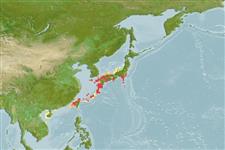
Northwest Pacific: Ryukyu Is., Japan.
ขนาด / น้ำหนัก / อายุ
วัยเจริญพันธุ์: Lm ? range ? - ? cm
Max length : 2.2 cm SL เพศผู้/กระเทย; (Ref. 84000); 2.0 cm SL (female)
คำอธิบายสั้นๆ
เครื่องมือที่ใช้ในการแยกชนิดสัตว์,สิ่งมีชีวิตออกจากกัน | สัณฐานวิทยา | ความยาวต่างๆ
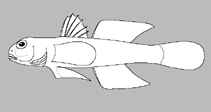
เงี่ยงครีบหลัง (รวม) : 7; ก้านครีบอ่อนที่หาง (รวม) : 9; เงี่ยงครีบก้น: 1; ก้านครีบอ่อนที่ก้น: 8; สัตว์มีกระดูกสันหลัง: 26. This species is distinguished in having the following characters: an expanded lateral wing of the cleithrum with a distinct, anterolaterally-directed triangular mid-lateral margin; D VI-I,9; A I,8; head depressed, depth 75.7-86.7% of width; lower jaw robust and prominent; mental frenum undeveloped; gill opening narrow, extending dorsally to a horizontal line through base of third, fourth or fifth pectoral-fin ray; tongue relatively narrow, anterior tip rounded or near pointed; sensory papillae rows on cheek representing essentially a longitudinal pattern, with short row b not extending anteriorly to a vertical through middle of eye; row c uniserial and long; row cp transverse, comprising 2-3 papillae; sensory papillae 2-4 (usually 3 or 4) forming a transverse row just behind chin (= row f); sensory canals on head well developed, with pores B', C (unpaired), D (unpaired), E, F, G, H', K', L', M', N and O'; vertebrae 10+16+26; P-V 3/II II I I 0/9 (Ref. 84000).
Found solitary under rubbles on sandy and pebble bottoms in protected bays at depths of 2-3 m (Ref. 84000).
วงจรชีวิตและพฤติกรรมการผสมพันธุ์
วัยเจริญพันธุ์ | การสืบพันธุ์ | การวางไข่ | เซลสืบพันธ์ของเพศเมีย(ไข่) | ความดกของไข่ | ตัวอ่อน
Shibukawa, K., T. Suzuki and H. Senou, 2010. Phoxacromion kaneharai, a new genus and species of gobiid fish (Teleostei: Perciformes: Gobiidae) from the Ryukyu Islands, Japan. Bull. Natl. Mus. Nat. Sci., Ser. A, (Suppl. 4):107-117. (Ref. 84000)
สถานะบัญชีแดงของ IUCN (Ref. 130435: Version 2025-2 (Global))
ภัยคุกคามต่อมนุษย์
Harmless
การใช้ของมนุษย์
เครื่องมือ
รายงานพิเศษ
ดาวน์โหลด XML
แหล่งที่มาจากอินเตอร์เน็ต
การประมาณค่าตามแบบจำลอง
อุณหภูมิที่ต้องการ (อ้างอิง
123201): 20.5 - 26.2, mean 23.5 °C (based on 113 cells).
ดัชนีความหลากหลายทางวิวัฒนาการ (อ้างอิง
82804): PD
50 = 1.0000 [Uniqueness, from 0.5 = low to 2.0 = high].
Bayesian length-weight: a=0.00741 (0.00347 - 0.01582), b=3.09 (2.91 - 3.27), in cm total length, based on LWR estimates for this (Sub)family-body shape (Ref.
93245).
ระดับชั้นอาหาร (อ้างอิง
69278): 3.1 ±0.3 se; based on size and trophs of closest relatives
ความสามารถในการกลับคืนสู่ปกติ (อ้างอิง
120179): ความสูง, เวลาต่ำสุดที่จะทำให้ประชากรเพิ่มขึ้นเป็น 2 เท่าใช้เวลาน้อยกว่า 15 เดือน (Preliminary K or Fecundity.).
ความเสี่ยงต่อการตกปลา (Ref.
59153): Low vulnerability (10 of 100).
🛈