分类 / 名称
俗名 | 同种异名 | Catalog of Fishes(属, 种) | ITIS | CoL | WoRMS | Cloffa
Teleostei >
Gobiiformes (Gobies) >
Microdesmidae (Wormfishes) > Ptereleotrinae
Etymology: Parioglossus: Greek, pareia = jaw + Greek, glossa = tongue (Ref. 45335); caeruleolineatus: Name from Latin 'caeruleo' for blue and 'lineatus' for line, referring to the distinct bright blue stripe running from nape to dorsum of caudl peduncle in males when alive or still fresh.
环境:氛围 / 气候带 / 深度上下限 / 分布范围
生态学
海洋 底中水层性; 深度上下限 0 - 1 m (Ref. 84007).
分布
领土 | FAO区域 | 生态系 | 标本纪录 | 分布图 | 简介 | Faunafri
Northwest Pacific: Ryukyus, Japan.
大小 / 重量 / 年龄
成熟度: Lm ? range ? - ? cm
Max length : 2.7 cm SL 雄鱼/尚未辨别雌雄; (Ref. 84007); 2.6 cm SL (female)
简单描述
检索表 | 型态特徵 | 形态测量图
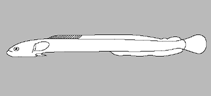
背棘 (总数) : 7; 背的软条 (总数) : 15; 臀棘: 1; 臀鳍软条: 15 - 16; 脊椎骨: 26. This species differs from its congeners in having a gently oblique mouth at an angle of 51-58° (average 55°) to longitudinal axis of body, and in possessing a bright blue stripe running from nape to dorsum of caudal peduncle in male when fresh or alive (Ref. 84007).
Body shape (shape guide): elongated.
This species normally swims in schools during high tide or hides in holes on muddy bottoms
mixed with pebbles around the roots of mangroves in river mouths. During low tide, they leave the holes and gather in schools in the mangroves at a depth of about 1 m (Ref. 84007).
生命周期和交配行为
成熟度 | 繁殖 | 产卵场 | 卵 | 孕卵数 | 仔鱼
Suzuki, T., T. Yonezawa and J. Sakaue, 2010. Three new secies of the ptereleotrid fish genus Parioglossus (Perciformes: Gobioidei) from Japan, Palau and India. Bull. Natl. Mus. Nat. Sci., Ser. A, (Suppl. 4):31-48. (Ref. 84007)
世界自然保护联盟红皮书 (Ref. 130435: Version 2025-2 (Global))
人类利用
工具
特别资料
下载 XML
网络资源
基于模型的估算
系统发育多样性指数 (参考文献
82804): PD
50 = 0.5000 [Uniqueness, from 0.5 = low to 2.0 = high].
Bayesian length-weight: a=0.00389 (0.00180 - 0.00842), b=3.12 (2.94 - 3.30), in cm total length, based on all LWR estimates for this body shape (Ref.
93245).
营养阶层 (参考文献
69278): 3.1 ±0.4 se; based on size and trophs of closest relatives
渔业脆弱性 (Ref.
59153): Low vulnerability (10 of 100).
🛈