>
Mulliformes (Goatfishes) >
Mullidae (Goatfishes)
Etymology: Upeneus: Greek, ypene, -es = upper lip (Ref. 45335); suahelicus: Name from the Arabic 'sawahil' meaning coast and this refers to the occurrence of this species off the East African coast.
Ambiente: milieu / zona climática / intervalo de profundidade / gama de distribuição
Ecologia
marinhas associadas(os) a recifes; intervalo de profundidade 20 - 99 m (Ref. 83903). Tropical
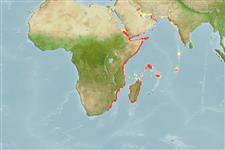
Western Indian Ocean: Kenya to South Africa, Eritrea (Red Sea).
Tamanho / Peso / Idade
Maturidade: Lm ? range ? - ? cm
Max length : 13.5 cm SL macho/indeterminado; (Ref. 83903)
Descrição breve
Chaves de identificação | Morfologia | Morfometria
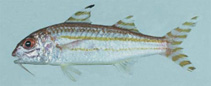
Espinhos dorsais (total) : 8; Raios dorsais moles (total) : 9. This species is distinguished by the following characters: D VIII,9; pectoral fins 15-16; gill rakers 6-8 + 19-21 = 26-28; lateral line scales 34-35; body depth at first dorsal-fin origin 26-30% SL and at anal-fin origin 22-26% SL; caudal-peduncle depth 9.9-11% SL; maximum head depth 22-25% SL; head depth through eye 17-19% SL; head length 28-31%SL; orbit length 7.1-9.4% SL; upper jaw length 12-14% SL; barbel length 15-20% SL; caudal-fin length 26-30% SL; anal-fin height 15-17% SL; pelvic-fin length 18-21% SL; pectoral-fin length 25-26% SL; first dorsal-fin height 22-26% SL; second dorsal-fin height 16-18% SL; 8-10 total bars on caudal fin, 4-6 brown bars on upper caudal-fin lobe, 3-4 of same color on lower lobe with the 3 proximal bars on upper lobe slightly curved with caudal-fin bars and white interspaces nearly equal width in width; in preserved specimens, all bars entirely retained. Fresh fish with 2 yellow or pale brown lateral body stripes, one close to lateral line, reaching from behind head to caudal-fin base, and another one below, starting behind pectoral-fin base; tip of first dorsal-fin dark, also in preserved fish; barbels white; head and body silvery white laterally and reddish-brown darker dorsally, belly white; in preserved fish, body pale brown, sometimes dorsally darkened (Ref. 82903).
Body shape (shape guide): fusiform / normal.
Ciclo de vida e comportamento de acasalamento
Maturidade | Reprodução | Desova | Ovos | Fecundidade | Larvas
Uiblein, F. and P.C. Heemstra, 2010. A taxonomic review of the Western Indian Ocean goatfishes of the genus Upeneus (Family Mullidae), with descriptions of four new species. Smithiana 11:35-71. (Ref. 83903)
Categoria na Lista Vermelha da IUCN (Ref. 130435: Version 2025-2 (Global))
Ameaça para o homem
Harmless
Utilização humana
Ferramentas
Relatórios especiais
Descarregue XML
Fontes da internet
Estimativas baseadas em modelos
Temperatura preferida (Ref.
123201): 23.7 - 27, mean 25.9 °C (based on 23 cells).
Índice de diversidade filogenética (Ref.
82804): PD
50 = 0.5000 [Uniqueness, from 0.5 = low to 2.0 = high].
Bayesian length-weight: a=0.00933 (0.00439 - 0.01983), b=3.09 (2.92 - 3.26), in cm total length, based on LWR estimates for this Genus-body shape (Ref.
93245).
Nível Trófico (Ref.
69278): 3.4 ±0.4 se; based on size and trophs of closest relatives
Resiliência (Ref.
120179): Elevada, tempo mínimo de duplicação da população menor que 15 meses (Preliminary K or Fecundity.).
Vulnerabilidade da pesca (Ref.
59153): Low vulnerability (10 of 100).
🛈