Classificazione / Nomi
Nomi Comuni | Sinonimi | Catalog of Fishes(Genere, Specie) | ITIS | CoL | WoRMS | Cloffa
>
Carangaria/misc (Various families in series Carangaria) >
Polynemidae (Threadfins)
Etymology: Polydactylus: Greek, poly = a lot of + greek, daktylos = finger (Ref. 45335); luparensis: The specific name luparensis is based on the Batang Lupar River in reference to the holotype locality. Local name of this species is Gemian.
Ambiente: milieu / zona climatica / distribuzione batimetrica / gamma di distribuzione
Ecologia
; acqua dolce pelagico; distribuzione batimetrica 3 - 5 m (Ref. 83753). Tropical; 2°N - 1°N, 111°E - 112°E
Asia: Malaysia, Borneo. Currently known only from the mouth of the Batang Lupar River, Borneo, Malaysia (Ref. 83753).
Dimensione / Peso / Età
Maturità: Lm ? range ? - ? cm
Max length : 72.0 cm SL maschio/sesso non determinato; (Ref. 83753)
Breve descrizione
Chiavi di identificazione | Morfologia | Morfometria
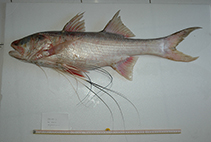
Spine dorsali (totale) : 9; Raggi dorsali molli (totale) : 13; Spine anali: 3; Raggi anali molli: 11. A species of Polydactylus that differs from all of its congeners by the following combination of characters: 8 dorsal-fin spines, first spine tiny, second spine very strong (its width more than 5 times of width of remaining spines); 13 second dorsal-fin soft rays; 11 anal-fin soft rays; 12 pectoral-fin rays, its length 22–24% (mean 23%) of SL, posterior tip not reaching a vertical through posterior tip of depressed pelvic fin; 6 pectoral filaments, fourth or fifth filament longest, its length 77–85% (mean 81%) of SL, posterior tip extending slightly beyond caudal-fin base; pored lateral-lined scales 67–75 (mean 71); lateral line unbranched, extending onto upper end of lower caudal-fin lobe; 6 scale rows above lateral line, 8 below; 14 gill rakers on upper limb, 18 on lower limb, 32 in total; occipital profile concave; posterior margin of maxilla extending considerably beyond a vertical through posterior margin of adipose eyelid; depth of posterior margin of maxilla 4–5% (mean 5%) of SL, greater than orbit diameter; well-developed swimbladder present; basal half of third to sixth pectoral filament white, becoming black distally. Polydactylus luparensis can be easily distinguished from all Indo-Pacific congeners by having the black distal half of the third to sixth pectoral filaments (whitish in the latter). Only two other taxa, Polynemus melanochir dulcis Motomura & Sabaj, 2002 and P. melanochir melanochir Valenciennes in Cuvier & Valenciennes, 1831, in the family Polynemidae have the black pectoral filaments (Motomura & Sabaj, 2002; Motomura, 2004b) (Ref. 83753).
Inhabiting turbid brackish water. The species is abundant in the river mouth especially from June to August and mainly caught by gill nets. Juveniles have also been observed in the same place (local fishermen, pers. comm.) (Ref. 83753).
Ciclo vitale e comportamento di accoppiamento
Maturità | Riproduzione | Deposizione | Uova | Fecondità | Larve
Lim, P.K.A., H. Motomura and A.C. Gambang, 2010. Polydactylus luparensis, a new species of threadfin (Perciformes: Polynemidae) from the Batang Lupar River, Sarawak, Borneo, Malaysia. Zootaxa 2405:63-68. (Ref. 83753)
Stato della Lista Rossa IUCN (Ref. 130435: Version 2025-2 (Global))
Minaccia per l'uomo
Harmless
Usi umani
Strumenti
Rapporti speciali
Scarica XML
Fonti Internet
Stime basate su modelli
Indice di diversità filogenetica (Fonte Biblio.
82804): PD
50 = 0.5000 [Uniqueness, from 0.5 = low to 2.0 = high].
Bayesian length-weight: a=0.00537 (0.00259 - 0.01116), b=3.07 (2.88 - 3.26), in cm total length, based on LWR estimates for this (Sub)family-body shape (Ref.
93245).
Livello trofico (Fonte Biblio.
69278): 3.8 ±0.5 se; based on size and trophs of closest relatives
Resilienza (Fonte Biblio.
120179): Medio, tempo minimo di raddoppiamento della popolazione 1.4 - 4.4 anni (Preliminary K or Fecundity.).
Vulnerabilità della pesca (Ref.
59153): High vulnerability (55 of 100).
🛈