>
Tetraodontiformes (Puffers and filefishes) >
Tetraodontidae (Puffers) > Canthigasterinae
Etymology: Canthigaster: Greek, kanthos = the outer or inner corner of the eye, where the lids meet, 1646 + Greek, gaster = stomach (Ref. 45335); axiologus: The species name axiologus stems from the Greek words αξίος and λόγος, the latter Latinised to logus; it is a noun in apposition and does not change its ending, though Canthigaster is feminine (Ref. 88002).
More on author: Whitley.
Ambiente: milieu / zona climática / intervalo de profundidade / gama de distribuição
Ecologia
marinhas associadas(os) a recifes; intervalo de profundidade 10 - 80 m (Ref. 90102). Tropical
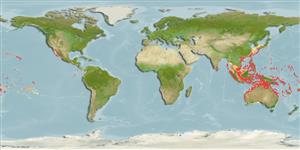
Pacific: Japan to Australia, east to the Marshall Islands and Tonga; with records from Western Australia, from Exmouth Gulf northwards.
Tamanho / Peso / Idade
Maturidade: Lm ? range ? - ? cm
Max length : 10.1 cm SL macho/indeterminado; (Ref. 83660)
Descrição breve
Chaves de identificação | Morfologia | Morfometria
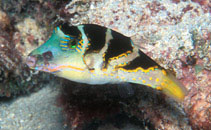
Raios dorsais moles (total) : 9 - 11; Raios anais moles: 9 - 10. This species is distinguished by the following characters: D 9-11 (usually 10, rarely 11); A 9-10 (usually 9); pectoral rays 15-18 (modally 16 in the North Pacific and 17 in the South Pacific); gill rakers 7-9; body depth between origins of dorsal and anal fins 3.0-3.3 in SL; head length (HL) 2.3-2.5 in SL; interorbital width 3.75-4.4 in HL; gill opening 4.8-5.55 in HL; origin of anal fin below or posterior to rear base of dorsal fin, the preanal length 1.25-1.35 in SL; longest dorsal ray 2.4-2.9 in HL; preserved colour pale grey to pale tan with 3 saddle-like, dark brown bars on body, similar to C. coronata, the edges of bars with close-set, small, pale-edged dark spots or short lines, irregularly alternating with unpigmented pale spots or lines; ventral part of body with or without small pale spots or pale-edged dark spots; across posterior interorbital and anterior occiput is a broad dark brown band; below base of pectoral fin is a dark brown spot; from chin to below gill opening, a narrow curved pale band edged in small dark spots; around eye is a pale area with radiating dark brown lines (except adjacent interorbital band); on head and abdomen is a midventral dark brown line varying from faint to conspicuous; lips pale, usually rimmed by a dusky band; fins pale grey, the upper and lower edges of caudal fin with or without a broad dark marginal band (Ref. 83660).
Body shape (shape guide): short and / or deep; Cross section: angular.
Occurs in sheltered habitat, often on open sand and rubble bottom near reefs; but appears to be far less common than C. coronata (Ref. 83660). Solitary (Ref. 90102).
Ciclo de vida e comportamento de acasalamento
Maturidade | Reprodução | Desova | Ovos | Fecundidade | Larvas
Randall, J.E., J.T. Williams and L.A. Rocha, 2008. The Indo-Pacific tetraodontid fish Canthigaster coronata, a complex of three species. Smithiana, Publ. Aquatic Biodiv. Bull. 9:3-13. (Ref. 83660)
Categoria na Lista Vermelha da IUCN (Ref. 130435: Version 2025-2 (Global))
Ameaça para o homem
Harmless
Utilização humana
Ferramentas
Relatórios especiais
Descarregue XML
Fontes da internet
Estimativas baseadas em modelos
Temperatura preferida (Ref.
123201): 24.1 - 29, mean 27.8 °C (based on 566 cells).
Índice de diversidade filogenética (Ref.
82804): PD
50 = 0.5000 [Uniqueness, from 0.5 = low to 2.0 = high].
Bayesian length-weight: a=0.03631 (0.01540 - 0.08559), b=2.88 (2.69 - 3.07), in cm total length, based on LWR estimates for this Genus-body shape (Ref.
93245).
Nível Trófico (Ref.
69278): 3.1 ±0.3 se; based on size and trophs of closest relatives
Resiliência (Ref.
120179): Elevada, tempo mínimo de duplicação da população menor que 15 meses (Preliminary K or Fecundity.).
Vulnerabilidade da pesca (Ref.
59153): Low vulnerability (10 of 100).
🛈
Nutrientes (Ref.
124155): Calcium = 107 [49, 256] mg/100g; Iron = 0.976 [0.481, 2.314] mg/100g; Protein = 18 [16, 20] %; Omega3 = 0.14 [0.07, 0.28] g/100g; Selenium = 38.9 [18.4, 87.6] μg/100g; VitaminA = 59.1 [16.2, 235.1] μg/100g; Zinc = 1.73 [1.12, 2.61] mg/100g (wet weight);