Classificação / Nomes
Nomes comuns | Sinônimos | Catalog of Fishes(Gênero, Espécies) | ITIS | CoL | WoRMS | Cloffa
>
Gymnotiformes (Knifefishes) >
Apteronotidae (Ghost knifefishes) > Apteronotinae
Etymology: Porotergus: Greek, poros = porous + Latin, tergum = back, the upper plate or segment in an animal (Ref. 45335); duende: The specific epithet, duende, is the Portuguese for elf or imp, referring to the diminutive size of P. duende. A noun in apposition. Gender masculine.
Meio ambiente: milieu / Zona climática / intervalo de profundidade / faixa de distribuição
Ecologia
; Água doce demersal; pH range: 6.9 - 7.3. Tropical; 27°C - 32°C (Ref. 83661)
Known from the main channel of the Amazon River in the western portions of the Amazon basin (Rio Negro and Rio Solimões in Brazil, Rio Ucayali in Peru.
Tamanho / Peso / Idade
Maturidade: Lm ? range ? - ? cm
Max length : 18.4 cm TL macho/indeterminado; (Ref. 83661); 10.4 cm TL (female)
Descrição suscinta
Chaves de identificação | Morfologia | Morfometria
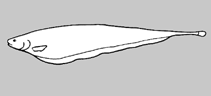
Raios anais : 124 - 142. This species is distinguished from its congeners by the following characted: presence of a light brown body pigmentation (vs. pale straw pigmentation in P. gimbeli, and dark brown in P. gymnotus); one row of conical teeth on the dentary (vs. two); edentulous premaxilla (vs. presence of teeth); ossified second basibranchial (vs. unossified in P. gimbeli, condition unknown in P. gymnotus). It further differs from P. gimbeli by the absence of a distinct swelling on the chin (vs. presence of this structure), the total anal-fin rays (124-142 vs. 171–198), and the prepectoral-fin distance (14.1-17.0% of LEA vs. 10.3-13.5); from P. gymnotus by the distance from the posterior naris to the eye (1.7-3.8% of HL vs. 8.2-11.9), mouth length (12.4-27.4% of HL vs. 28.1-38.7), pectoral-fin length (72.7-89.0% of HL vs. 60.4-70.7) (Ref. 83661).
Body shape (shape guide): elongated; Cross section: compressed.
This species is known mainly from the main channels of large whitewater rivers such as the Rio Solimões(Amazon) and Río Ucayali. In the Tefé region, it was encountered only during the rising water period in January and February, and captured in waters of 2–4 m depth on beaches of alluvial silt and fine sand. Based on examined stomachs of four specimens, this species feeds exclusively on small, autochthonous, benthic insect larvae (of micro-caddis fly, biting midge and beetle). Most specimens had loose sand grains in the stomach (larger than the grains of sand in the caddis fly jackets), suggesting foraging on sandy substrates; one stomach contained many endoparasitic nematodes. All four specimens captured in the Tefé region had maturing, but not fully mature, gonads, suggesting that spawning occur during the rising water period, typical of riverine apteronotids (Ref. 83661).
Ciclo de vida ou comportamento de acasalamento
Maturidade | Reprodução | Desova | Ovos | Fecundidade | Larvas
de Santana, C. D. and G. R. Crampton, 2010. A review of the South American electric fish genus Porotergus (Gymnotiformes: Apteronotidae) with the description of a new species. Copeia 2010(1):165-175. (Ref. 83661)
Status na Lista Vermelha da UICN (Ref. 130435: Version 2025-2 (Global))
Ameaça para os humanos
Harmless
Uso pelos humanos
Ferramentas
Relatórios especiais
Baixar XML
Fontes da internet
Estimativas baseadas em modelos
Índice de diversidade filogenética (Ref.
82804): PD
50 = 0.5625 [Uniqueness, from 0.5 = low to 2.0 = high].
Bayesian length-weight: a=0.00355 (0.00146 - 0.00863), b=3.06 (2.85 - 3.27), in cm total length, based on LWR estimates for this (Sub)family-body shape (Ref.
93245).
Nível Trófico (Ref.
69278): 3.3 ±0.3 se; based on size and trophs of closest relatives
Vulnerabilidade da pesca (Ref.
59153): Low vulnerability (10 of 100).
🛈