Klassifizierung / Names
Namen | Synonyme | Catalog of Fishes(Gattung, Arten) | ITIS | CoL | WoRMS | Cloffa
>
Perciformes/Uranoscopoidei (Sand dwellers) >
Ammodytidae (Sand lances)
Etymology: Ammodytoides: Greek, ammos = sand + Greek, dytes = anyone that likes immersions, diving (Ref. 45335); xanthops: Name from the Greek 'xanthos' for yellow and 'ops' for face, referring to the dominant yellow colour of the head dorsally and anterior to the eye.
More on authors: Randall & Heemstra.
Umwelt: Milieu / Klimazone / Tiefenbereich / Verbreitungsgebiet
Ökologie
seewasser pelagic-neritic; tiefenbereich 26 - 62 m (Ref. 83531). Tropical
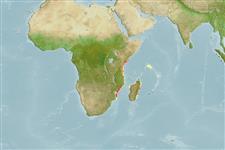
Western Indian Ocean: Mozambique.
Größe / Gewicht / Alter
Geschlechtsreife: Lm ? range ? - ? cm
Max length : 12.2 cm SL Männchen/unbestimmt; (Ref. 83531)
Kurzbeschreibung
Bestimmungsschlüssel | Morphologie | Morphometrie
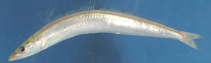
Rückenflossenweichstrahlen (insgesamt) : 48 - 49; Afterflossenweichstrahlen: 23 - 24; Wirbelzahl: 57 - 59. This species is distinguished by the following characters: D 48-49; A 23-24; pectoral rays 15-16 (usually 15); lateral-line scales 106-112; absence of small scales dorsally on opercle; gill rakers 5-6 + 22-25; vertebrae 57-59; body depth 10.0-11.7% SL; eye diameter 3.3-3.5% SL; when fresh dark purplish gray dorsally, pale silvery blue on sides and ventrally; yellow on interorbital and most of head anterior to eye; dusky on front of snout and tip of lower jaw; series of 6-7 black spots at edge of dorsal fin; without black dots in fins; caudal fin with a broad blackish posterior border (Ref. 83531).
Body shape (shape guide): elongated.
Lebenszyklus und Paarungsverhalten
Geschlechtsreife | Fortpflanzung | Ablaichen | Eier | Fruchtbarkeit | Larven
Randall, J.E. and P.C. Heemstra, 2008. Ammodytes xanthops, a new species of sandlance (Perciformes: Ammodytidae) from Mozambique. Smithiana,, Publications in Aquatic Biodiversity, Bulletin No. 9: 21-25. (Ref. 83531)
IUCN Rote Liste Status (Ref. 130435: Version 2025-2 (Global))
Bedrohung für Menschen
Harmless
Nutzung durch Menschen
Tools
Zusatzinformationen
Download XML
Internet Quellen
Schätzungen auf der Grundlage von Modellen
Bevorzugte Temperatur (Ref.
123201): 25.3 - 26.7, mean 26.1 °C (based on 8 cells).
Phylogenetischer Diversitätsindex (Ref.
82804): PD
50 = 0.5010 [Uniqueness, from 0.5 = low to 2.0 = high].
Bayesian length-weight: a=0.00324 (0.00142 - 0.00739), b=3.07 (2.88 - 3.26), in cm total length, based on LWR estimates for this (Sub)family-body shape (Ref.
93245).
Trophische Ebene (Ref.
69278): 3.2 ±0.4 se; based on size and trophs of closest relatives
Widerstandsfähigkeit (Ref.
120179): hoch, Verdopplung der Population dauert weniger als 15 Monate. (Preliminary K or Fecundity.).
Anfälligkeit der Fischerei (Ref.
59153): Low vulnerability (10 of 100).
🛈