>
Elopiformes (Tarpons and tenpounders) >
Elopidae (Tenpounders)
Etymology: Elops: Greek, ellops = a kind of serpent (Ref. 45335); smithi: Named for David G. Smith, Smithsonian Institution.
Eponymy: Dr David G Smith is an American ichthyologist who is a Museum Specialist at the Smithsonian Institution. [...] (Ref. 128868), visit book page.
Environnement : milieu / zone climatique / profondeur / gamme de distribution
Écologie
marin; saumâtre pelagic-neritic. Tropical
Western Atlantic: coasts of the Americas, the Bahamas, and the Caribbean islands.
Taille / Poids / Âge
Maturité: Lm ? range ? - ? cm
Max length : 44.0 cm mâle / non sexé; (Ref. 83481)
Description synthétique
Clés d'identification | Morphologie | Morphométrie
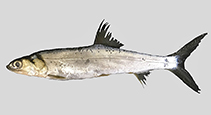
Rayons mous dorsaux (Total) : 24 - 27; Rayons mous anaux: 16 - 19; Vertèbres: 73 - 80. This species is distinguished from Elops saurus in the number of vertebrae 73-80 but usually 75-78 vs. 79-87, often 81-85, respectively (vs. E. senegalensis 67, E. machnata 63-64, and E. hawaiensis 68-70). This species has a lower gill raker count , 10-15 on lower limb of the first arch (vs. E. affinis 16-20 and E. lacerta 17-19) (Ref. 83481).
Body shape (shape guide): elongated.
Occurs in a wide range of salinities; mature adults and early-life history stages in offshore marine habitats and where spawning is presumed to occur; and transforming larvae and subadults in estuaries, as far up as the oligohaline zone, as well as hypersaline lagoons (Ref. 83481).
Cycle de vie et comportement reproducteur
Maturité | Reproduction | Frai | Œufs | Fécondité | Larves
McBride, R.S., C.R. Rocha, R. Ruiz-Carus and B.W. Bowen, 2010. A new species of ladyfish, of the genus Elops (Elopiformes: Elopidae), from the western Atlantic Ocean. Zootaxa 2346:29-41. (Ref. 83481)
Statut dans la liste rouge de l'IUCN (Ref. 130435: Version 2025-2 (Global))
Menace pour l'homme
Harmless
Utilisations par l'homme
Outils
Articles particuliers
Télécharger en XML
Sources Internet
Estimations basées sur des modèles
Indice de diversité phylogénétique (Réf.
82804): PD
50 = 0.5176 [Uniqueness, from 0.5 = low to 2.0 = high].
Bayesian length-weight: a=0.00617 (0.00269 - 0.01415), b=2.99 (2.80 - 3.18), in cm total length, based on LWR estimates for this (Sub)family-body shape (Ref.
93245).
Niveau trophique (Réf.
69278): 3.9 ±0.5 se; based on size and trophs of closest relatives
Vulnérabilité de la pêche (Ref.
59153): High to very high vulnerability (66 of 100).
🛈