Classification / Noms
Noms communs | Synonymes | Catalog of Fishes(Genre, Espèce) | ITIS | CoL | WoRMS | Cloffa
>
Characiformes (Characins) >
Acestrorhamphidae (American tetras) > Hyphessobryconinae
Etymology: Hyphessobrycon: Greek, hyphesson, -on, -on = a little smaller + Greek, bryko = to bite (Ref. 45335); sebastiani: Named for the younger brother of Carlos García-Alzate, Sebastian.
Eponymy: Sebastian García-Alzate is the senior author’s younger brother. (Ref. 128868), visit book page.
Environnement : milieu / zone climatique / profondeur / gamme de distribution
Écologie
; eau douce benthopélagique. Tropical
South America: middle section of the San Juan River drainage, Pacific versant of Colombia.
Taille / Poids / Âge
Maturité: Lm ? range ? - ? cm
Max length : 4.6 cm SL mâle / non sexé; (Ref. 83523)
Description synthétique
Clés d'identification | Morphologie | Morphométrie
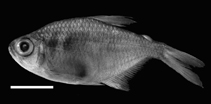
Rayons mous dorsaux (Total) : 11; Vertèbres: 33. The presence of two humeral spots and the absence of caudal blotch separate this species from all congeners, except Hyphessobrycon bifasciatus, Hyphessobrycon balbus, Hyphessobrycon colombianus, Hyphessobrycon flammeus, Hyphessobrycon griemi, Hyphessobrycon itaparicensis, Hyphessobrycon savagei, Hyphessobrycon togoi and Hyphessobrycon weitzmanorum. Differs from those species in having the following characters: a higher number of branched pectoral-fin rays (12-13 vs. 10-11); a higher number of branched anal-fin rays (25-28 vs.17-24); a higher number of lateral scales (35-37 vs. 30-32); a higher number of scales between the lateral line and the base of the dorsal fin (eight vs. five to seven); a higher number of unbranched anal–fin rays (five vs. three to four unbranched); presence of three pairs of large bony hooks on anal fin of the mature males (vs. one or two pairs); a higher number of pored lateral-line scales (13-18 vs. 8-13, except Hyphessobrycon balbus with 11-22 and Hyphessobrycon togoi with 8-14) (Ref. 83523).
Body shape (shape guide): short and / or deep.
Based on 3 specimens, this species feeds mainly on insects (Ref. 83523).
Cycle de vie et comportement reproducteur
Maturité | Reproduction | Frai | Œufs | Fécondité | Larves
García-Alzate, C.A., C. Román-Valencia and D.C. Taphorn, 2010. A new species of Hyphessobrycon (Teleostei: Characiformes: Characidae) from the San Juan River drainage, Pacific versant of Colombia. Zootaxa 2349:55-64. (Ref. 83523)
Statut dans la liste rouge de l'IUCN (Ref. 130435: Version 2025-2 (Global))
Menace pour l'homme
Harmless
Utilisations par l'homme
Outils
Articles particuliers
Télécharger en XML
Sources Internet
Estimations basées sur des modèles
Indice de diversité phylogénétique (Réf.
82804): PD
50 = 0.5000 [Uniqueness, from 0.5 = low to 2.0 = high].
Bayesian length-weight: a=0.01995 (0.00906 - 0.04395), b=3.01 (2.83 - 3.19), in cm total length, based on all LWR estimates for this body shape (Ref.
93245).
Niveau trophique (Réf.
69278): 2.9 ±0.3 se; based on size and trophs of closest relatives
Vulnérabilité de la pêche (Ref.
59153): Low vulnerability (10 of 100).
🛈