>
Kurtiformes (Nurseryfishes, cardinalfishes.) >
Apogonidae (Cardinalfishes) > Apogoninae
Etymology: umbratilis: Name from a Latin word meaning 'of the shade', retired or private, referring to the
observed cryptic behavior.
Milieu: milieu / Klimaatzone / Diepte / verspreidingsgebied
Ecologie
marien pelagic-neritic; diepte 20 - 60 m (Ref. 90102). Tropical
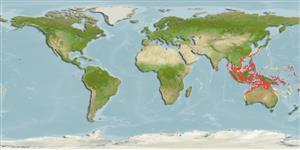
East Indian to Western Pacific: Western Australia, Indonesia, Brunei and Palau.
Grootte / Gewicht / Leeftijd
Maturiteit: Lm ? range ? - ? cm
Max length : 4.1 cm SL mannelijk / geslacht onbekend; (Ref. 83499)
Korte beschrijving
Determinatiesleutels | Morfologie | Morfometrie
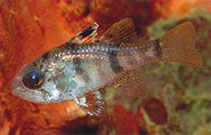
Dorsale stekels (totaal) : 8; Dorsale zachte stralen (totaal) : 9 - 10; Anale stekels: 2; Anale zachte stralen: 8 - 9. This species is characterized by having a blackish spot on the first-dorsal fin; 5 brownish bars on body and caudal peduncle; broad faint cheek mark; high postocular darkish spot; 14 pectoral-fin rays with a tiny to small darkish spot above the axil (Ref. 83499).
Body shape (shape guide): short and / or deep; Cross section: compressed.
This species is usually found solitary or in pairs at about 10-40 meters. It also displays a cryptic behavior, at least during daylight hours, sheltering between rocks and rubble. It has not been observed free swimming, but only when flushed from its lair with the use of clove-oil or rotenone. Specimens collected were living in a rubble field in sheltered waters at the base of a small islet or were found under rock slabs on a submerged patch reef (several km from shore) with abundant sponges and gorgonians and minimal hard corals. Some specimens were also collected from a flat sand and shell bottom with abundant Gonipora, some Fungia and considerable macroalgae (Ref. 83499).
Levenscyclus en paargedrag
Maturiteit | Voortplanting | Paaien | Eieren | Fecunditeit | Larven
Mouthbrooders. Distinct pairing during courtship and spawning (Ref. 205).
Fraser, T.H. and G.R. Allen, 2010. Cardinalfish of the genus Apogonichthyoides Smith, 1949 (Apogonidae) with a description of a new species from the West-Pacific region. Zootaxa 2348:40-56. (Ref. 83499)
Status op de Rode Lijst van het IUCN (Ref. 130435: Version 2025-2 (Global))
Gevaar voor de mens
Harmless
Gebruik door de mens
Visserij: van geen belang
Tools
Speciale rapporten
Download XML
Internetbronnen
Schattingen op basis van modellen
Gewenste temperatuur (Ref.
123201): 24.3 - 28.5, mean 27.6 °C (based on 221 cells).
Fylogenetische diversiteitsindex (Ref.
82804): PD
50 = 0.5000 [Uniqueness, from 0.5 = low to 2.0 = high].
Bayesian length-weight: a=0.01514 (0.00700 - 0.03275), b=3.07 (2.89 - 3.25), in cm total length, based on LWR estimates for this (Sub)family-body shape (Ref.
93245).
Trofisch niveau (Ref.
69278): 3.3 ±0.5 se; based on size and trophs of closest relatives
Kwetsbaarheid van de visserij (Ref.
59153): Low vulnerability (10 of 100).
🛈