การจำแนกประเภท / ชื่อ
ชื่อสามัญ | ชื่อพ้อง | Catalog of Fishes(สกุล, ชนิด) | ITIS | CoL | WoRMS | Cloffa
สิ่งแวดล้อม : สิ่งแวดล้อม / เขตภูมิอากาศ / ระดับความลึก / ระยะการกระจายสินค้า
นิเวศวิทยา
; น้ำจืด สัตว์น้ำหน้าดิน. Tropical
Asia: Indonesia. Muna Island, southeast of Sulawesi (Ref. 83398).
ขนาด / น้ำหนัก / อายุ
วัยเจริญพันธุ์: Lm ? range ? - ? cm
Max length : 8.0 cm SL เพศผู้/กระเทย; (Ref. 83398)
คำอธิบายสั้นๆ
เครื่องมือที่ใช้ในการแยกชนิดสัตว์,สิ่งมีชีวิตออกจากกัน | สัณฐานวิทยา | ความยาวต่างๆ
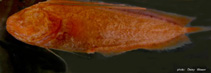
This species is distinct within the genus by being eyeless, with dorsal fin rays (78-81) and head length (30.5-32.5%). Further distinguished by the following, vertebrae 11-12 + 29-30; anal fin rays 63-65; long gill rakers 3-4; pseudobranchial filaments absent; scales on cheek in a narrow patch, none on the opercle; pointed outer pseudoclasper only slightly longer than inner pseudoclasper, the pseudoclaspers are connected anteriorly; color in life red (Ref. 83398).
Body shape (shape guide): elongated.
This species is easily caught y hand nets for these kept close to the rocks often upside down. An interesting nocturnal migration was observed in Moko Morete as dozens of fish from the lightless parts of the cave appeared in the blue hole after dark. There was much more food available in the blue hole than in the oligotrophic cave habitat as the blue hole was exposed to daylight all day long. It was also risky to stay in the blue hole as many specimens were eaten by snakes. The salinity in the caves vary, 5-10 ppm in the surface layers and about 30 ppm in the bottom layers with a sharp halocline at 15-20 m depth. The absence of eyes indicates that the species has evolved under dark cave conditions. The presence of long, retrorse fangs also indicate that they can take relatively large prey. The only identifiable stomach content, judged from radiographs, is two 2 mm long gastropods. Two females have eggs up to 0.8 mm in diameter, but no embryos were found. The 6.2 cm SL female had about 250 eggs 0.6-0.8 mm in diameter. Four males have a well-developed intromittent organ and histological sections of the testes of one of these (MNHN 2009-0154) show numerous spermatophores in the testicular duct (Ref. 83398).
วงจรชีวิตและพฤติกรรมการผสมพันธุ์
วัยเจริญพันธุ์ | การสืบพันธุ์ | การวางไข่ | เซลสืบพันธ์ของเพศเมีย(ไข่) | ความดกของไข่ | ตัวอ่อน
Nielsen, J.G., W. Schwarzhans and R.K. Hadiaty, 2009. A blind, new species of Diancistrus (Teleostei, Bythitidae) from three caves on Muna Island, southeast of Sulawesi, Indonesia. Cybium 33(3):241-245. (Ref. 83398)
สถานะบัญชีแดงของ IUCN (Ref. 130435: Version 2025-2 (Global))
ภัยคุกคามต่อมนุษย์
Harmless
การใช้ของมนุษย์
เครื่องมือ
รายงานพิเศษ
ดาวน์โหลด XML
แหล่งที่มาจากอินเตอร์เน็ต
การประมาณค่าตามแบบจำลอง
ดัชนีความหลากหลายทางวิวัฒนาการ (อ้างอิง
82804): PD
50 = 0.5000 [Uniqueness, from 0.5 = low to 2.0 = high].
Bayesian length-weight: a=0.00389 (0.00180 - 0.00842), b=3.12 (2.94 - 3.30), in cm total length, based on all LWR estimates for this body shape (Ref.
93245).
ระดับชั้นอาหาร (อ้างอิง
69278): 3.3 ±0.5 se; based on size and trophs of closest relatives
ความเสี่ยงต่อการตกปลา (Ref.
59153): Low vulnerability (10 of 100).
🛈