Classificação / Nomes
Nomes comuns | Sinônimos | Catalog of Fishes(Gênero, Espécies) | ITIS | CoL | WoRMS | Cloffa
>
Siluriformes (Catfishes) >
Loricariidae (Armored catfishes) > Loricariinae
Etymology: parakana: The species name, parakana, is in reference to the Parakanã, inhabitants of the margins of the lower rio Tocantins, in the State of Pará. Parakanã, an American group that historically inhabited the area of the lower rio Tocantins, drainage from whi.
Eponymy: Francesca Raimonde La Monte (1895–1982) was an ichthyologist who worked at the AMNH (1920–1968). [...] The Parakanã are an indigenous people who used to live in the area of the lower Rio Tocantins, Pará, Brazil, where the holotype was collected. (Ref. 128868), visit book page.
Meio ambiente: milieu / Zona climática / intervalo de profundidade / faixa de distribuição
Ecologia
; Água doce demersal. Tropical
South America: Brazil. Known from the type locality at lower rio Tocantins, below Tucuruí Dam (Ref. 83332).
Tamanho / Peso / Idade
Maturidade: Lm ? range ? - ? cm
Max length : 13.1 cm SL macho/indeterminado; (Ref. 83332)
Descrição suscinta
Chaves de identificação | Morfologia | Morfometria
This species is distinguished from its congeners by the following characters: position of the anal-fin is more anterior with its origin situated anterior to the vertical through the distal tip of the last dorsal-fin ray (vs. anal-originating posteriorly); it differs further (except with L. avacanoeiro and L. stibaros) in lacking plates on the anterior tip of the snout (vs. snout entirely covered with plates or with an inconspicuous naked area), in teeth having long cusps (vs. short), and having a longer dentary in specimens larger than 50 mm SL, 20.1-22.6%, (vs. 11.5-19.1% HL); differs from L. filamentosus and L. llanero in having a semi-oval shaped lower lip (vs. semicircular shaped); similar to L. avacanoeiro and L. stibaros, but from which it may be distinguished by having a broader head 101.3-106.1% (vs. 78.9-101.4% HL) and the greater orbital diameter 16.6-17.3%, (vs. 13.7-15.5% HL), in specimens larger than 10.0 cm SL; also differs from L. avacanoeiro in having a longer first branched dorsal-fin ray 26.4-31.0% (vs. 20.5-26.7% SL) (Ref.83332).
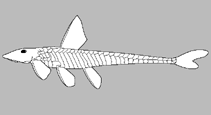
Body shape (shape guide): elongated; Cross section: other (see remarks).
Ciclo de vida ou comportamento de acasalamento
Maturidade | Reprodução | Desova | Ovos | Fecundidade | Larvas
de Carvalho Paixão, A. and M. Toledo-Piza, 2009. Systematics of Lamontichthys Miranda-Ribeiro (Siluriformes: Loricariidae), with the description of two new species. Neotrop. Ichthyol. 7(4):519-568. (Ref. 83332)
Status na Lista Vermelha da UICN (Ref. 130435: Version 2025-2 (Global))
Ameaça para os humanos
Harmless
Uso pelos humanos
Ferramentas
Relatórios especiais
Baixar XML
Fontes da internet
Estimativas baseadas em modelos
Índice de diversidade filogenética (Ref.
82804): PD
50 = 0.5156 [Uniqueness, from 0.5 = low to 2.0 = high].
Bayesian length-weight: a=0.00398 (0.00185 - 0.00857), b=3.11 (2.93 - 3.29), in cm total length, based on LWR estimates for this (Sub)family-body shape (Ref.
93245).
Nível Trófico (Ref.
69278): 2.5 ±0.2 se; based on size and trophs of closest relatives
Resiliência (Ref.
120179): médio(a), tempo mínimo de duplicação da população 1,4 - 4,4 anos (Preliminary K or Fecundity.).
Vulnerabilidade da pesca (Ref.
59153): Low vulnerability (10 of 100).
🛈