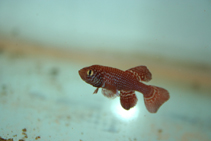
Classificatie / Namen
Lokale namen | Synoniemen | Catalog of Fishes(Genus, Soort(en)) | ITIS | CoL | WoRMS | Cloffa
>
Cyprinodontiformes (Rivulines, killifishes and live bearers) >
Nothobranchiidae (African rivulines)
Etymology: Nothobranchius: Greek, nothos = false + Greek, brangchia = gill (Ref. 45335); kadleci: The species is named in honour of the late Jaroslav Kadlec (1951-2006) from Brno, Czech republic, a renowned killifish breeder recognized worldwide for his articles on killifish breeding, ecology, and his photographs; to be pronounced 'khadlatsi' (Ref. 83370).
Eponymy: Jaroslav Kadlec (1951–2006) from Brno, Czech Republic, was a renowned aquarist, recognised worldwide for his articles on the ecology and breeding of killifish. (Ref. 128868), visit book page.
Milieu: milieu / Klimaatzone / Diepte / verspreidingsgebied
Ecologie
; zoet water pelagisch; diepte 0 - 1 m (Ref. 83370). Tropical; 28°C - 38°C (Ref. 83370); 19°S - 21°S
Africa: central Mozambique, north of the Save River, including Save, Gorongose, Pungwe and Zangue rivers (Ref. 83370).
Lengte bij maturiteit / Grootte / Gewicht / Leeftijd
Maturiteit: Lm 3.1 range ? - ? cm
Max length : 3.9 cm SL mannelijk / geslacht onbekend; (Ref. 83370)
Korte beschrijving
Determinatiesleutels | Morfologie | Morfometrie
Dorsale stekels (totaal) : 0; Dorsale zachte stralen (totaal) : 13 - 14; Anale stekels: 0; Anale zachte stralen: 13 - 16. Diagnosis: Nothobranchius kadleci is distinguished from N. furzeri by the smaller depth of the dorsal fin, 17.9-31.0% of standard length vs. 27.4-37.7% in males, 14.9-17.6% of standard length vs. 19.0-21.9% in females; smaller depth of the anal fin, 17.4-25.8% of standard length vs. 22.4-32.4% in males, 17.3-19.2% of standard length vs.19.3-24.5% in females; larger preanal distance, 64.0-65.8% of standard length vs. 58.9-61.3%, in females; presence of red colour on gill membrane and lips and red pectoral fins vs. no red colour on gill membrane and lips and typically yellow pectoral fins in N. furzeri; absence of black marginal band on caudal fin, present in some male N. furzeri; and a higher amount of red on caudal and dorsal fins and on body in males (Ref. 83370). It is distinguished from sympatric N. orthonotus, including putative N. kuhntae and N. mayeri, by the shape of the frontal region, convex in N. kadleci vs. flat in N. orthonotus; the presence of red pectoral fins with white margins, often with a bluish tint, vs. N. orthonotus with transparent or whitish pectoral fins with red margins; red background colour on the head covered with small to large light blue marking, vs. N. orthonotus with red spots on white to grey background colour of the head and, in most populations, also on anterior ventral part of the body; shorter preanal distance, 58.4-61.2% of standard length vs. 62.7-72.5%; and distance between pelvic and anal fins, 10.2-13.5% of standard length vs. 13.4-16.6%, in males (Ref. 83370). This species also differs from sympatric N. rachovii in males by lack of black margin of the caudal fin; distance between pectoral and pelvic fins, 15.1-21.7% of standard length vs. 12.8-16.7%; minimal body depth 15.0-16.9% of standard length vs. 13.5-15.4%; eye diameter 22.1-27.3% of head length vs. 26.0-32.6%; in females by preanal distance, 64.0-65.8% of standard length vs. 61.8-64.5%; length of caudal peduncle, 20.1-21.6% of standard length vs. 13.4-20.1%; depth of dorsal fin, 14.9-17.6% of standard length vs. 16.8-23.2%; and depth of anal fin, 17.3-19.2% of standard length vs. 21.0-23.2% (Ref. 83370).
Body shape (shape guide): fusiform / normal.
The altitude of collection sites ranged from 24-82 m above sea level (Ref. 83370). It is found in small temporary pools varying from 3.5-2150 m², with a maximum depth of 100 cm, very turbid water and soft muddy bottom; littoral vegetation was present in the pools, sometimes with scarce Nymphaea vegetation (Ref. 83370).
Levenscyclus en paargedrag
Maturiteit | Voortplanting | Paaien | Eieren | Fecunditeit | Larven
Reichard, M., 2010. Nothobranchius kadleci (Cyprinodontiformes: Nothobranchiidae), a new species of annual killifish from central Mozambique. Zootaxa 2332:49-60. (Ref. 83370)
Status op de Rode Lijst van het IUCN (Ref. 130435: Version 2025-2 (Global))
Gevoelig (NT) (B1ab(iii)+2ab(iii)); Date assessed: 09 December 2018
Gevaar voor de mens
Harmless
Gebruik door de mens
Tools
Speciale rapporten
Download XML
Internetbronnen
Schattingen op basis van modellen
Fylogenetische diversiteitsindex (Ref.
82804): PD
50 = 0.5000 [Uniqueness, from 0.5 = low to 2.0 = high].
Bayesian length-weight: a=0.01096 (0.00461 - 0.02608), b=2.94 (2.74 - 3.14), in cm total length, based on LWR estimates for this (Sub)family-body shape (Ref.
93245).
Trofisch niveau (Ref.
69278): 3.2 ±0.4 se; based on size and trophs of closest relatives
Weerstandsvermogen (Ref.
120179): Hoog, minimale populatieverdubbelingstijd minder dan 15 maanden (tm=0.04).
Kwetsbaarheid van de visserij (Ref.
59153): Low vulnerability (10 of 100).
🛈