Entorno: milieu / zona climática / rango de profundidad / gama de distribución
Ecología
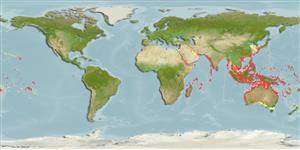
marino; salobre asociado a arrecife; rango de profundidad 3 - 58 m (Ref. 1602). Tropical; 36°N - 48°S, 24°E - 132°W
Indo-Pacific: Red Sea and East Africa eastward through Indonesia to Tuamotus, northward to southern Japan, southward to Lord Howe Island.
Tamaño / Peso / Edad
Madurez: Lm ? range ? - ? cm
Max length : 120 cm TL macho / no sexado; (Ref. 9710); common length : 54.0 cm TL macho / no sexado; (Ref. 5450)
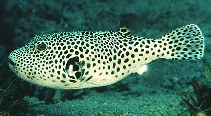
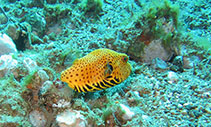
Espinas dorsales (total) : 0; Radios blandos dorsales (total) : 10 - 12; Espinas anales: 0; Radios blandos anales: 10 - 11. Body covered with prickles (Ref. 559). Juveniles with dark stripes on belly, becoming spots with growth; adults with or without spots on fin (Ref. 4919).
Body shape (shape guide): short and / or deep.
Relatively uncommon in patch reefs and coral slopes near sandy areas of clear lagoon and seaward reefs. Juveniles occur in sandy and weedy inner reefs, adults on clear lagoons and seaward reefs (Ref. 9710). Juveniles inshore, usually on muddy substrates and often estuarine. Adults on deep slopes and range to outer reefs, sometimes swimming high above the substrate or just below the surface. Pelagic larvae may disperse over great distance and juveniles occur in subtropical zone (Ref. 48637). Enter estuaries (Ref. 4833). Considered as the giant among puffers reaching a total length well in excess of a meter.
Ciclo vital y comportamiento de apareamiento
Madurez | Reproducción | Puesta | Huevos | Fecundidad | Larva
Masuda, H., K. Amaoka, C. Araga, T. Uyeno and T. Yoshino, 1984. The fishes of the Japanese Archipelago. Vol. 1. Tokai University Press, Tokyo, Japan. 437 p. (text). (Ref. 559)
Situación en la Lista Roja de la UICN (Ref. 130435: Version 2025-2 (Global))
Amenaza para el ser humano
Poisonous to eat (Ref. 559)
Usos humanos
Pesquerías: de interés potencial
Herramientas
Informes especiales
Descargar XML
Fuentes de Internet
Estimaciones basadas en modelos
Temperatura preferida (Referencia
123201): 22.4 - 29, mean 27.8 °C (based on 1224 cells).
Índice de diversidad filogenética (Referencia
82804): PD
50 = 0.5000 [Uniqueness, from 0.5 = low to 2.0 = high].
Bayesian length-weight: a=0.05012 (0.03065 - 0.08197), b=2.86 (2.72 - 3.00), in cm total length, based on LWR estimates for this species & Genus-body shape (Ref.
93245).
Nivel trófico (Referencia
69278): 3.7 ±0.2 se; based on diet studies.
Resiliencia (Referencia
120179): Bajo, población duplicada en un tiempo mínimo de 4.5-14 años (Preliminary K or Fecundity.).
Vulnerabilidad pesquera (Ref.
59153): High to very high vulnerability (72 of 100).
🛈
Nutrientes (Ref.
124155): Calcium = 18 [7, 47] mg/100g; Iron = 0.429 [0.222, 0.944] mg/100g; Protein = 18.9 [16.7, 21.0] %; Omega3 = 0.102 [0.053, 0.196] g/100g; Selenium = 45.7 [22.5, 100.0] μg/100g; VitaminA = 28.6 [7.6, 110.0] μg/100g; Zinc = 0.832 [0.550, 1.275] mg/100g (wet weight);