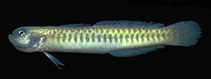
Klassifizierung / Names
Namen | Synonyme | Catalog of Fishes(Gattung, Arten) | ITIS | CoL | WoRMS | Cloffa
>
Gobiiformes (Gobies) >
Microdesmidae (Wormfishes) > Ptereleotrinae
Etymology: Pterocerdale: Name from the arbitrary combination of letters from Ptereleotrinae + Cerdale, relating to the placement in the Ptereleotrinae and similarity to the microdesmine genus Cerdale; insolita: From the Latin insolitus = strange, unusual, uncommon, all features of the new species. An
adjective.
More on authors: Hoese & Motomura.
Umwelt: Milieu / Klimazone / Tiefenbereich / Verbreitungsgebiet
Ökologie
; süßwasser demersal. Tropical
Oceania: Australia.
Größe / Gewicht / Alter
Geschlechtsreife: Lm ? range ? - ? cm
Max length : 4.4 cm SL (female)
Kurzbeschreibung
Bestimmungsschlüssel | Morphologie | Morphometrie
Rückenflossenstacheln (insgesamt) : 7; Rückenflossenweichstrahlen (insgesamt) : 19; Afterflossenstacheln: 1; Afterflossenweichstrahlen: 18; Wirbelzahl: 26. This species is distinguished by the following characters: lower lip with free ventral margin posteriorly only; compressed head and body; elongate body; nape, cheek, preoperculum and operculum almost completely covered with scales; body covered with cycloid scales, imbricate, in 105 vertical rows; terminal mouth slightly protractile, forming an angle of about 60° to longitudinal axis of body; maxilla reaching posteriorly to below front margin of eye; head pores are all paired laterally, 5 pores around dorsal margin of each eye; relatively short and rounded snout, with length subequal to eye diameter; anterior nostril is at the end of short tube while posterior nostril is a simple pore; no teeth on vomer, tongue and palatines; conical teeth slightly curved; 2 rows on upper jaw, small, loosely attached anteriorly while teeth in outer row slightly larger, widely spaced; lower jaw with single row of loosely attached, small teeth directed dorsally, without enlarged curved canines visible in holotype; along outer edge of dentary is a series of blunt bony dorsoventrally flattened projections with rounded tip directed more or less horizontally (widely-spaced projections appear to be bony projections of dentary, not true teeth, but probably tooth sockets), space between projections about equal to width of projections; tongue tip is broadly rounded; head papillae in transverse pattern; median nuchal crest, formed by low fold of skin from first dorsal spine onto head, low; gill opening vertical, extending ventrally from pectoral-fin base below upper margin to point just below lower pectoral base, below operculum; fleshy interorbital is subequal to diameter of eye; D1 VI, D2 I,19; A I,18; pectoral-fin rays 19; segmented caudal rays 9+8; branched caudal rays 8+7; pelvic fins are separate I,4; vertebrae 12+14 (Ref. 83368).
Body shape (shape guide): elongated; Cross section: compressed.
Lebenszyklus und Paarungsverhalten
Geschlechtsreife | Fortpflanzung | Ablaichen | Eier | Fruchtbarkeit | Larven
Hoese, D.F. and H. Motomura, 2009. Descriptions of two new genera and species of ptereleotrine fishes from Australia and Japan (Teleostei: Gobioidei) with discussion of possible relationships. Zootaxa 2312:49-59. (Ref. 83368)
IUCN Rote Liste Status (Ref. 130435: Version 2025-2 (Global))
Bedrohung für Menschen
Harmless
Nutzung durch Menschen
Tools
Zusatzinformationen
Download XML
Internet Quellen
Schätzungen auf der Grundlage von Modellen
Phylogenetischer Diversitätsindex (Ref.
82804): PD
50 = 1.0000 [Uniqueness, from 0.5 = low to 2.0 = high].
Bayesian length-weight: a=0.00389 (0.00180 - 0.00842), b=3.12 (2.94 - 3.30), in cm total length, based on all LWR estimates for this body shape (Ref.
93245).
Trophische Ebene (Ref.
69278): 3.2 ±0.4 se; based on size and trophs of closest relatives
Anfälligkeit der Fischerei (Ref.
59153): Low vulnerability (10 of 100).
🛈