>
Lophiiformes (Anglerfishes) >
Brachionichthyidae (Handfishes)
Etymology: Pezichthys: Name from Greek 'pezo' (walking) and 'ichthys' (fish), referring to the ability of these fishes to walk on the sea floor using their hand-like pelvic fins and arm-like pectoral fins; nigrocilium: Name from Latin 'niger' (black) and 'cilium' (eyelash), referring to a dark, eyelash-like markings above each orbit.
More on authors: Last & Gledhill.
Ambiente: milieu / zona climatica / distribuzione batimetrica / gamma di distribuzione
Ecologia
marino demersale. Temperate
Eastern Indian Ocean: Tasmania, Australia.
Dimensione / Peso / Età
Maturità: Lm ? range ? - ? cm
Max length : 4.1 cm SL maschio/sesso non determinato; (Ref. 82446)
Breve descrizione
Chiavi di identificazione | Morfologia | Morfometria
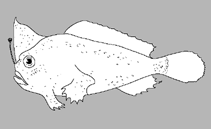
Raggi dorsali molli (totale) : 17; Raggi anali molli: 8. This species is distinguished by the following combination of characters: small esca, 11% of illicium length (including esca); short, very slender illicium, without dermal spinules, its length about 16% SL, 3.5 times in head length; head length about 9 times snout length; short snout, length 6% SL; eye large, 5.6 times in head length; narrow body, maximum width 19% SL; interorbital width narrow, about 5% SL; scale bases subcircular with prominent, strongly divergent, bifurcate spinules (except for those closely associated with pores of the acoustico-lateralis system); spinules variable in length over body; dorsal-fin elements covered with spinules, outer fin membranes naked; first dorsal-fin base short, length 15% SL; second dorsal-fin rays 15, fin base about 57% SL; length of second dorsal-fin spine 1.4 times length of longest ray of second dorsal fin; anal-fin rays 8; body is predominantly pale pink with prominent eyelash-like marking radiating from eye; caudal fin plain, without fine spots (Ref. 82446).
Body shape (shape guide): elongated.
Ciclo vitale e comportamento di accoppiamento
Maturità | Riproduzione | Deposizione | Uova | Fecondità | Larve
Last, P. and D.C. Gledhill, 2009. A revision of the Australian handfishes (Lophiiformes: Brachionichthyidae), with descriptions of three new genera and nine new species. Zootaxa 2252:1-77. (Ref. 82446)
Stato della Lista Rossa IUCN (Ref. 130435: Version 2025-2 (Global))
Minaccia per l'uomo
Harmless
Usi umani
Strumenti
Rapporti speciali
Scarica XML
Fonti Internet
Stime basate su modelli
Indice di diversità filogenetica (Fonte Biblio.
82804): PD
50 = 0.5313 [Uniqueness, from 0.5 = low to 2.0 = high].
Bayesian length-weight: a=0.00437 (0.00164 - 0.01162), b=3.12 (2.89 - 3.35), in cm total length, based on LWR estimates for this (Sub)family-body shape (Ref.
93245).
Livello trofico (Fonte Biblio.
69278): 3.4 ±0.4 se; based on size and trophs of closest relatives
Vulnerabilità della pesca (Ref.
59153): Low vulnerability (10 of 100).
🛈