>
Ovalentaria/misc (Various families in series Ovalentaria) >
Pomacentridae (Damselfishes) > Chrominae
Etymology: Chromis: Greek, chromis = a fish, perhaps a perch (Ref. 45335); albicauda: Name from Latin meaning 'white tail' for its diagnostic feature that separates this species from Chromis analis.
Entorno: milieu / zona climática / rango de profundidad / gama de distribución
Ecología
marino asociado a arrecife; rango de profundidad 25 - 70 m (Ref. 90102), usually ? - 30 m (Ref. 82433). Tropical
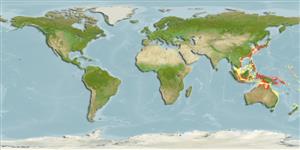
Western Pacific: Indonesia and southern Japanese seas; distribution probably disjunct due to association with cool temperature regimes.
Tamaño / Peso / Edad
Madurez: Lm ? range ? - ? cm
Max length : 13.4 cm SL macho / no sexado; (Ref. 82433)
Descripción breve
Claves de identificación | Morfología | Morfometría
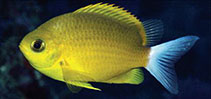
Espinas dorsales (total) : 13; Radios blandos dorsales (total) : 11 - 12; Espinas anales: 2; Radios blandos anales: 11 - 12. This species is distinguished by the following characters: D XIII,12 (rarely 11); A II,12 (rarely 11); pectoral rays 18-20; spiniform caudal rays 3; tubed lateral-line scales 17-19; gill rakers 7-8 + 24-26, total rakers 24-26; body depth 1.8-1.9 in SL; edge of suborbital hidden by scales; 4-5 scale rows on anterior portion of preorbital; generally yellow in life, grading to brown on upper back with abruptly white caudal fin; blackish anal opening which is also evident in preserved specimens (Ref. 82433).
Body shape (shape guide): short and / or deep.
Adults are commonly observed in areas of cool (18°-24°C) upwelling along the northern and western shores of Nusa Penida at about 25-50 m. They typically form aggregations, which feed high in the water column on zooplankton when currents are strong (Ref. 82433). Oviparous, distinct pairing during breeding (Ref. 205). Eggs are demersal and adhere to the substrate (Ref. 205). Males guard and aerate the eggs (Ref. 205).
Ciclo vital y comportamiento de apareamiento
Madurez | Reproducción | Puesta | Huevos | Fecundidad | Larva
Oviparous, distinct pairing during breeding (Ref. 205). Eggs are demersal and adhere to the substrate (Ref. 205). Males guard and aerate the eggs (Ref. 205).
Allen, G.R. and M.V. Erdmann, 2009. Two new species of damselfishes (Pomacentridae: Chromis) from Indonesia. aqua, Int. J. Ichthyol. 15(3):121-134. (Ref. 82433)
Situación en la Lista Roja de la UICN (Ref. 130435: Version 2025-2 (Global))
Amenaza para el ser humano
Harmless
Usos humanos
Pesquerías: pesquerías de subsistencia
Herramientas
Informes especiales
Descargar XML
Fuentes de Internet
Estimaciones basadas en modelos
Índice de diversidad filogenética (Referencia
82804): PD
50 = 0.5000 [Uniqueness, from 0.5 = low to 2.0 = high].
Bayesian length-weight: a=0.01778 (0.00800 - 0.03953), b=3.00 (2.82 - 3.18), in cm total length, based on LWR estimates for this Genus-body shape (Ref.
93245).
Nivel trófico (Referencia
69278): 3.0 ±0.1 se; based on size and trophs of closest relatives
Resiliencia (Referencia
120179): Medio, población duplicada en un tiempo mínimo de 1.4-4.4 años (Preliminary K or Fecundity.).
Vulnerabilidad pesquera (Ref.
59153): Low vulnerability (10 of 100).
🛈