Classificação / Nomes
Nomes comuns | Sinónimos | Catalog of Fishes(Género, Espécies) | ITIS | CoL | WoRMS | Cloffa
>
Cyprinodontiformes (Rivulines, killifishes and live bearers) >
Nothobranchiidae (African rivulines)
Etymology: Nothobranchius: Greek, nothos = false + Greek, brangchia = gill (Ref. 45335); ruudwildekampi: Named in honor of Ruud Wildekamp, in recognition for his fine taxonomic work on the genus Nothobranchius (Ref. 83284).
Eponymy: Rudolf ‘Ruud’ Hans Wildekamp (1945–2019) was honoured for his taxonomic work on the genus Nothobranchius. (See Wildekamp) (Ref. 128868), visit book page.
More on author: Costa.
Ambiente: milieu / zona climática / intervalo de profundidade / gama de distribuição
Ecologia
; Água doce pelágico(a,os,as). Tropical
Africa: Mbezi River basin, eastern Tanzania (Ref. 83284).
Tamanho / Peso / Idade
Maturidade: Lm ? range ? - ? cm
Max length : 2.5 cm SL macho/indeterminado; (Ref. 83284)
Descrição breve
Chaves de identificação | Morfologia | Morfometria
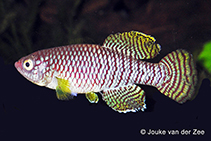
Espinhos dorsais (total) : 0; Raios dorsais moles (total) : 13 - 15; Espinhos anais: 0; Raios anais moles: 15 - 17; Vértebras: 28 - 29. This species is similar to Nothobranchius korthausae and distinguished from the remaining congeners by the combination of caudal fin with transverse bars, dorsal and anal fins with white distal margin, and a blue blotch on the distal portion of the pectoral in males (Ref. 83284). It is distinguished from N. korthausae by having minute horizontally elongated dark gray spots on the posterior portion of the pectoral fin in males, absence of subdistal black bars on the unpaired fins in males, absence of white distal margin on the caudal fin in males, 7-9 reddish brown bars on the anal fin in males, 27-29 caudal fin rays, and main condyle of the second pharyngobranchial straight (Ref. 83284). Dorsal profile convex from snout to end of dorsal-fin base, nearly straight to slightly concave on caudal peduncle; ventral profile gently convex from lower jaw to end of anal-fin base, approximately straight on caudal peduncle; body slender, compressed, greatest body depth at level of pelvic-fin base (Ref. 83284). Extremity of dorsal and anal fins rounded, posteriorly reaching caudal-fin base; short filamentous rays along distal margin of dorsal and anal fins; caudal fin subtruncate; pectoral fin approximately triangular, tip reaching vertical between pelvic-fin base and anus (Ref. 83284). Frontal squamation G-patterned; E-scales overlapping medially; no row of scales anterior to G-scale; no supraorbital scales (Ref. 83284).
Body shape (shape guide): fusiform / normal.
The type specimens originate from temporary shallow pools in open savanna area, with some shrubs near the pool margin; the water was brownish hyaline, slightly turbid, and water plants were abundant; pools were shallow, about 50 cm deep in deepest parts, but 5 days after collection, one pool was entirely dry (Ref. 83284).
Ciclo de vida e comportamento de acasalamento
Maturidade | Reprodução | Desova | Ovos | Fecundidade | Larvas
Costa, W.J.E.M., 2009. Species delimitation among populations of the eastern Tanzanian seasonal killifish Nothobranchius korthausae (Cyprinodontiformes: Nothobranchiidae). Ichthyol. Explor. Freshwat. 20(2):111-126. (Ref. 83284)
Categoria na Lista Vermelha da IUCN (Ref. 130435: Version 2025-2 (Global))
Ameaça para o homem
Harmless
Utilização humana
Pescarias: sem interesse
Ferramentas
Relatórios especiais
Descarregue XML
Fontes da internet
Estimativas baseadas em modelos
Índice de diversidade filogenética (Ref.
82804): PD
50 = 0.5000 [Uniqueness, from 0.5 = low to 2.0 = high].
Bayesian length-weight: a=0.01096 (0.00461 - 0.02608), b=2.94 (2.74 - 3.14), in cm total length, based on LWR estimates for this (Sub)family-body shape (Ref.
93245).
Nível Trófico (Ref.
69278): 3.1 ±0.4 se; based on size and trophs of closest relatives
Vulnerabilidade da pesca (Ref.
59153): Low vulnerability (10 of 100).
🛈