Klassifizierung / Names
Namen | Synonyme | Catalog of Fishes(Gattung, Arten) | ITIS | CoL | WoRMS | Cloffa
>
Mulliformes (Goatfishes) >
Mullidae (Goatfishes)
Etymology: Parupeneus: Latin, parum, parvum = small + Peneus, the name of a river; minys: Name from the Greek word for small, referring to its very small adult size for this genus.
More on authors: Randall & Heemstra.
Umwelt: Milieu / Klimazone / Tiefenbereich / Verbreitungsgebiet
Ökologie
seewasser riff-verbunden; tiefenbereich 43 - 55 m (Ref. 82838). Tropical
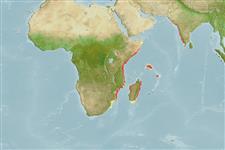
Western Indian Ocean: Mozambique, Seychelles and India.
Größe / Gewicht / Alter
Geschlechtsreife: Lm ? range ? - ? cm
Max length : 10.7 cm SL Männchen/unbestimmt; (Ref. 82838); 8.4 cm SL (female)
Kurzbeschreibung
Bestimmungsschlüssel | Morphologie | Morphometrie
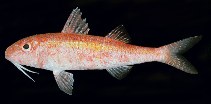
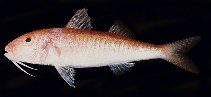
Rückenflossenstacheln (insgesamt) : 8; Rückenflossenweichstrahlen (insgesamt) : 9; Afterflossenstacheln: 0; Afterflossenweichstrahlen: 7; Wirbelzahl: 24. This species is distinguished by the following characters: pectoral-fin rays 15-16; gill rakers 6 + 21-22; elongated body, depth 3.95-4.3 in SL; head length 2.9-3.05 in SL; interorbital space flat medially; snout length 2.05-2.3 in HL; posterior edge of maxilla symmetrically convex with maximum depth of maxilla 5.45-5.8 in HL; barbel length 1.35-1.45 in HL; the longest dorsal spine 1.8-1.95 in HL; pectoral fins 1.3-1.4 in HL; pelvic fins 1.5-1.65 in HL; colour of alcohol preserved specimens uniform tan except those from the Seychelles with areas of white ventrally on head below eye and on lower two/fifths of body; dark markings absent; translucent fins pale yellowish. Colour when fresh, pink dorsally, pale pink to white ventrally, with an indistinct pale yellow stripe along lateral line; some lateral-line scales with a bluish white dash; a bluish white line encircling ventral part of eye and continuing obliquely to upper lip; 3 small bluish white blotches dorsally on head, one directly above eye; barbels white; median and pelvic fins translucent blotchy yellow with small pale blue to whitish spots along rays that outline faint transverse yellowish bands (Ref. 82838).
Body shape (shape guide): fusiform / normal.
Lebenszyklus und Paarungsverhalten
Geschlechtsreife | Fortpflanzung | Ablaichen | Eier | Fruchtbarkeit | Larven
Randall, J.E. and E. Heemstra, 2009. Three new goatfishes of the genus Parupeneus from the Western Indian Ocean, with resurrection of P. seychellensis. Smithiana Bulletin 10:37-50. (Ref. 82838)
IUCN Rote Liste Status (Ref. 130435: Version 2025-2 (Global))
Bedrohung für Menschen
Harmless
Nutzung durch Menschen
Tools
Zusatzinformationen
Download XML
Internet Quellen
Schätzungen auf der Grundlage von Modellen
Bevorzugte Temperatur (Ref.
123201): 25.5 - 26.1, mean 26.1 °C (based on 3 cells).
Phylogenetischer Diversitätsindex (Ref.
82804): PD
50 = 0.5000 [Uniqueness, from 0.5 = low to 2.0 = high].
Bayesian length-weight: a=0.01175 (0.00543 - 0.02542), b=3.09 (2.92 - 3.26), in cm total length, based on LWR estimates for this Genus-body shape (Ref.
93245).
Trophische Ebene (Ref.
69278): 3.3 ±0.4 se; based on size and trophs of closest relatives
Widerstandsfähigkeit (Ref.
120179): hoch, Verdopplung der Population dauert weniger als 15 Monate. (Preliminary K or Fecundity.).
Anfälligkeit der Fischerei (Ref.
59153): Low vulnerability (10 of 100).
🛈