Classificação / Nomes
Nomes comuns | Sinónimos | Catalog of Fishes(Género, Espécies) | ITIS | CoL | WoRMS | Cloffa
>
Cichliformes (Cichlids, convict blennies) >
Cichlidae (Cichlids) > Pseudocrenilabrinae
Etymology: Otopharynx: Greek, ous = hear + Greek, pharyngx = pharynx (Ref. 45335); spelaeotes: The specific epiteth is derived from the Greek and means cave dweller (Ref. 82798).
Ambiente: milieu / zona climática / intervalo de profundidade / gama de distribuição
Ecologia
; Água doce demersal. Tropical
Africa: Lake Malawi (Ref. 82798).
Tamanho / Peso / Idade
Maturidade: Lm ? range ? - ? cm
Max length : 11.7 cm SL macho/indeterminado; (Ref. 82798)
Descrição breve
Chaves de identificação | Morfologia | Morfometria
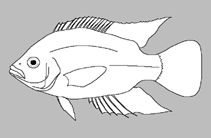
Espinhos dorsais (total) : 16 - 17; Raios dorsais moles (total) : 10 - 12; Espinhos anais: 3; Raios anais moles: 8 - 10. A medium-sized cave-dwelling haplochromine with relatively deep body with greatest body depth at base of eighth or ninth dorsal spine (Ref. 82798). Otopharynx spelaeotes has a larger eye, 36.1-38.4% of head length, than most other Otopharynx species, and it has fewer lateral-line scales, 31-33, than Otopharynx argyrosoma (Ref. 82798). It differs from Otopharynx lithobates by having more teeth in the outer row of the left lower jaw (18-24), fewer gill rakerson the ceratobranchial (11-13) and by the male breeding coloration that includes yellow/orange ocelli on the anal fin and a blue/black dorsal fin with a very narrow white margin with orange/red lappets (Ref. 82798). It is distinguished from Otopharynx antron by a larger horizontal eye diameter (36.1-38.4% of head length), a shallower caudal peduncle, and more teeth in the outer row of the left lower jaw (Ref. 82798).
This species has a preference for large caves and is therefore often found in rocky habitats that consist of large boulders (Ref. 82798). Most individuals are seen solitary and often at a depth of more than 10m (Ref. 82798). The mode of feeding consists of scavenging material lying on the rocky substrate of their environment (Ref. 82798).
Ciclo de vida e comportamento de acasalamento
Maturidade | Reprodução | Desova | Ovos | Fecundidade | Larvas
Cleaver, R.M., A.F. Konings and J.R. Stauffer Jr., 2009. Two new cave-dwelling cichlids of Lake Malaŵi, Africa. Ichthyol. Explor. Freshwat. 20(2):163-178. (Ref. 82798)
Categoria na Lista Vermelha da IUCN (Ref. 130435: Version 2025-2 (Global))
Ameaça para o homem
Harmless
Utilização humana
Ferramentas
Relatórios especiais
Descarregue XML
Fontes da internet
Estimativas baseadas em modelos
Índice de diversidade filogenética (Ref.
82804): PD
50 = 0.5000 [Uniqueness, from 0.5 = low to 2.0 = high].
Bayesian length-weight: a=0.00389 (0.00180 - 0.00842), b=3.12 (2.94 - 3.30), in cm total length, based on all LWR estimates for this body shape (Ref.
93245).
Nível Trófico (Ref.
69278): 3.4 ±0.4 se; based on size and trophs of closest relatives
Resiliência (Ref.
120179): Elevada, tempo mínimo de duplicação da população menor que 15 meses (Preliminary K or Fecundity.).
Vulnerabilidade da pesca (Ref.
59153): Low vulnerability (10 of 100).
🛈