>
Gobiiformes (Gobies) >
Gobiidae (Gobies) > Gobionellinae
Etymology: Gnatholepis: Greek, gnathos = jaw + Greek,lepis = scale (Ref. 45335); yoshinoi: Named for Tetsuo Yoshino of the University of the Ryukyus.
Eponymy: Tetsuo Yoshino is a Japanese ichthyologist who is a member of the Department of Marine Sciences at the University of the Ryukyus, Okinawa, having formerly been at Kyoto University. [...] (Ref. 128868), visit book page.
More on authors: Suzuki & Randall.
Environnement : milieu / zone climatique / profondeur / gamme de distribution
Écologie
marin benthopélagique; profondeur 1 - 12 m (Ref. 90102). Temperate
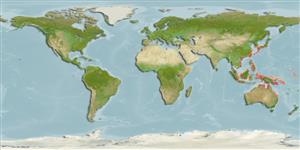
Western Pacific: Japan and Malaysia.
Taille / Poids / Âge
Maturité: Lm ? range ? - ? cm
Max length : 3.1 cm SL mâle / non sexé; (Ref. 82658)
Description synthétique
Clés d'identification | Morphologie | Morphométrie
Épines dorsales (Total) : 7; Rayons mous dorsaux (Total) : 10 - 11; Épines anales: 1; Rayons mous anaux: 11. This species is characterized by the following, D VI+I,10-11; A I,11; pectoral-fin rays 15; longitudinal scale series 27; cheek scales extending nearly to a vertical at anterior edge of orbit; median predorsal scales extending to posterior interorbital space; fully scaled prepectoral area; 2+4 gill rakers; body depth at origin of pelvic fins 3.9-4.25 in SL; very compressed body, width 1.55-1.8 in body depth; head length 3.25-3.3 in SL; first dorsal fin higher than second, with longest spine 1.25-1.5 in HL; caudal fin is longer than head, 2.7-2.8 in SL (Ref. 82658); moderately large Gnatholepis (up to 58 mm SL) with nape midline scales always cycloid and most of predorsal scales cycloid; body pale with 6-8 rows of staggered dark brown spots, mid-lateral spots may be largest; transverse black line on the upper part of the eye joining somewhat oblique to curved black line or bar crossing cheek and ending well behind end of jaw; third to fourth first dorsal fin spines longest, fin with square to rectangular appearance when extended; lateral scales 26-29, usually 27; 9-11 predorsal scales (usually 10), all cycloid (Ref. 92171).
Body shape (shape guide): fusiform / normal.
Inhabits mud-sand bottoms with Caulerpa green alga in 1-12 m (Ref. 90102).
Cycle de vie et comportement reproducteur
Maturité | Reproduction | Frai | Œufs | Fécondité | Larves
Suzuki, T. and J.E. Randall, 2009. Gnatholepis yoshinoi, a New gobiid fish from Okinawa, Japan. Bull. Natl. Mus. Nat. Sci. Ser. A 35(32):82-88. (Ref. 82658)
Statut dans la liste rouge de l'IUCN (Ref. 130435: Version 2025-2 (Global))
Menace pour l'homme
Harmless
Utilisations par l'homme
Outils
Articles particuliers
Télécharger en XML
Sources Internet
Estimations basées sur des modèles
Température préférée (Réf.
123201): 23.5 - 29.3, mean 28.6 °C (based on 995 cells).
Indice de diversité phylogénétique (Réf.
82804): PD
50 = 0.5010 [Uniqueness, from 0.5 = low to 2.0 = high].
Bayesian length-weight: a=0.01023 (0.00452 - 0.02316), b=3.00 (2.81 - 3.19), in cm total length, based on LWR estimates for this (Sub)family-body shape (Ref.
93245).
Niveau trophique (Réf.
69278): 3.2 ±0.5 se; based on size and trophs of closest relatives
Résilience (Réf.
120179): Haut, temps minimum de doublement de population inférieur à 15 mois (Preliminary K or Fecundity.).
Vulnérabilité de la pêche (Ref.
59153): Low vulnerability (10 of 100).
🛈