klasifikasi / Nama
Nama-nama umum | Sinonim (persamaan) | Catalog of Fishes(Marga, Jenis) | ITIS | CoL | WoRMS | Cloffa
>
Gobiesociformes (Clingfishes) >
Gobiesocidae (Clingfishes and singleslits) > Diademichthyinae
Etymology: Briggsia: Named for Dr. John C. Briggs, in recognition of his major contributions to clingfish systematics; hastingsi: Briggsia is named in honor of Dr. John C. Briggs, in recognition of his major contributions to
clingfish systematics.
hastingsi is named in honor of Dr. Philip A. Hastings, the thesis advisor of the first author, who initially aroused the.
Eponymy: John C ‘Jack’ Briggs (1920–2018) was a prominent scholar and a pioneer in the field of biogeography where his contributions are widely recognised. [...] Dr Philip Alan ‘Phil’ Hastings (d: 1951) is Professor of Marine Biology at Scripps Institution of Oceanography, University of California, San Diego and Curator of Marine Vertebrates. [...] (Ref. 128868), visit book page.
More on authors: Craig & Randall.
Lingkungan: lingkungan / zona iklim / kisaran kedalaman / jangkauan distribusi
Ekologi
laut berasosiasi dengan karang. Tropical; 17°N - 16°N, 54°E - 55°E
Indian Ocean: Oman, southeastern coast, Rahah Bay (Ref. 82558).
Ukuran / Berat / umur
Kematangan: Lm ? range ? - ? cm
Max length : 2.2 cm SL jantan/; (Ref. 82558)
deskripsi pendek
Kunci identifiaksi (pengenalan) | Morfologi | Morfometrik
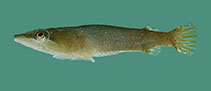
duri punggung lunak (Keseluruhan (total)) : 4; Sirip dubur lunak: 4; vertebrata, bertulang belakang: 29. A monotypic genus of Aspasminae with no prominent vertical ridges on side of body; head large,
its length 2.5 in SL; head width 3.9 in SL; body depth 6.1 in SL; disc double and moderately large, 3.9 in SL; dorsal and anal fins small, posterior on body, each with 4 rays; pectoral rays 23; gill rakers on second arch 9, on third arch 10 (Ref. 82558).
A species of aspasimine gobiesocid with dorsal and anal fins posterior on body, each with 4
rays; pectoral rays 23; caudal fin broad and rounded, with 10 principal rays; gill rakers on first gill arch 9, on third arch 10; head large, its length 2.5 in SL; body depth 6.1 in SL; disc double and well-separated; disc length 3.9 in SL; disc width 4.4 in SL; color in alcohol uniform tan; color when fresh dark reddish gray with
numerous blue dots on side of body except posteriorly, and a few on postorbital head; a dark purplish brown stripe from front of snout, continuing posterior to eye; head ventral to stripe yellowish white; a distinct orange
ring around pupil (Ref. 82558).
Body shape (shape guide): elongated.
Siklus hidup dan perilaku kawin
Kematangan | Reproduksi, perkembang biakan | Pemijahan | telur-telur | Fekunditas | Larva
Craig, M.T. and J.E. Randall, 2009. Briggsia hastingsi , a new genus and species of clingfish from Oman. Zootaxa 2271:64-68. (Ref. 82558)
Status IUCN Red List (Ref. 130435: Version 2025-2 (Global))
ancaman kepada manusia
Harmless
penggunaan manusia
Alat, peralatan
laporan khas
muat turun XML
Sumber internet
Estimasi berdasarkan model
Indeks keanekaragaman filogenetik (Acuan
82804): PD
50 = 1.0000 [Uniqueness, from 0.5 = low to 2.0 = high].
Bayesian length-weight: a=0.00389 (0.00180 - 0.00842), b=3.12 (2.94 - 3.30), in cm total length, based on all LWR estimates for this body shape (Ref.
93245).
Tingkat Trofik (Acuan
69278): 3.2 ±0.2 se; based on size and trophs of closest relatives
Kerentanan Penangkapan Ikan (Ref.
59153): Low vulnerability (10 of 100).
🛈