Classification / Noms
Noms communs | Synonymes | Catalog of Fishes(Genre, Espèce) | ITIS | CoL | WoRMS | Cloffa
>
Cypriniformes (Carps) >
Cobitidae (Spined loaches)
Etymology: Sabanejewia: Because of P. Sabanejev, expert in plankton.
Eponymy: Leonid Pavlovich Sabanejew, aka Sabaneev (1844–1898), was a Russian zoologist and an expert on freshwater fish biology. [...] (Ref. 128868), visit book page.
Environnement : milieu / zone climatique / profondeur / gamme de distribution
Écologie
; eau douce démersal. Temperate
Europe: Black Sea basin in Dniestr, Dniepr, and Don drainages; Baltic basin in Vistula and Odra drainages.
Longueur à la première maturité / Taille / Poids / Âge
Maturité: Lm 7.5, range 6 - 9 cm
Max length : 9.0 cm SL mâle / non sexé; (Ref. 59043)
Description synthétique
Clés d'identification | Morphologie | Morphométrie
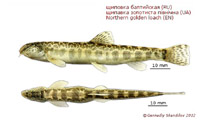
Presence of a midlateral row of dark blotches along flank. Ventral adipose crest on caudal peduncle absent or less developed than dorsal one. No row of small spots directly below midlateral blotches (if present, then most prominent between pelvic and anal bases). Dorsal origin above or in front of pelvic origin. Distance between the two black spots at caudal base much less than their diameter. Interspaces between midlateral blotches usually with dark pigmentation (if there is little or no dark pigmentation, then no dark spots in narrow whitish saddle behind head. Body above midlateral blotches uniform brown or with small whitish to yellowish spots or speckles.
Body shape (shape guide): elongated.
Adults occur in a wide array of habitats from small lowland streams to fast-flowing piedmont rivers with clear water and sand to gravel bottom. Usually do not occur in large lowland rivers. They are found burrowed in sand, avoiding mud or silt, sometimes in gravel (Ref. 59043). Mature individuals spawn in batches (Ref. 59043). Eggs, 1.1-1.2 mm in diameter, lay scattered over sand, gravel or other structures (Ref. 59043). Absence of external gill filaments in free larvae but transparent bump on forehead prominent (Ref. 59043). Larvae start to feed after 6 days at 3.1-4.2 mm TL (Ref. 59043).
Kottelat, M. and J. Freyhof, 2007. Handbook of European freshwater fishes. Publications Kottelat, Cornol and Freyhof, Berlin. 646 pp. (Ref. 59043)
Statut dans la liste rouge de l'IUCN (Ref. 130435: Version 2025-2 (Global))
Menace pour l'homme
Harmless
Utilisations par l'homme
Outils
Articles particuliers
Télécharger en XML
Sources Internet
Estimations basées sur des modèles
Indice de diversité phylogénétique (Réf.
82804): PD
50 = 0.5005 [Uniqueness, from 0.5 = low to 2.0 = high].
Bayesian length-weight: a=0.00501 (0.00233 - 0.01079), b=3.08 (2.90 - 3.26), in cm total length, based on LWR estimates for this (Sub)family-body shape (Ref.
93245).
Niveau trophique (Réf.
69278): 3.2 ±0.4 se; based on size and trophs of closest relatives
Résilience (Réf.
120179): Milieu, temps minimum de doublement de population : 1,4 à 4,4 années (Assumed Fec < 10,000).
Vulnérabilité de la pêche (Ref.
59153): Low vulnerability (10 of 100).
🛈