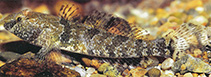
Classificazione / Nomi
Nomi Comuni | Sinonimi | Catalog of Fishes(Genere, Specie) | ITIS | CoL | WoRMS | Cloffa
>
Gobiiformes (Gobies) >
Gobiidae (Gobies) > Gobiinae
Etymology: Proterorhinus: Greek, proteros = former + Greek, rhinos = nose (Ref. 45335).
More on author: Heckel.
Ambiente: milieu / zona climatica / distribuzione batimetrica / gamma di distribuzione
Ecologia
; acqua dolce; salmastro benthopelagico. Temperate
Euorpe: Black Sea basin; Maritza and Struma drainages in eastern Aegean basin. In Danube, present up to about Vienna, invasive since 1970s, now reaching upstream to southern Germany. In South Bug and Dniepr native far upriver. Introduced to North America in 1991 through ballast of ships.
Dimensione / Peso / Età
Maturità: Lm ? range ? - ? cm
Max length : 9.0 cm SL maschio/sesso non determinato; (Ref. 59043)
Inhabits a variety of slow-flowing or still waters from estuarine to small, slow flowing premontane streams; usually in dense vegetation or coarse rocks, and often very abundant in backwaters and lakes, breeds in reservoirs and channels. Preys on benthic invertebrates. Spawns for the first time at 1-2 years, usually for 1-2 seasons only, in April to August. Females may spawn more than once during the season and males guard the eggs that are deposited in cavities. Larvae and juveniles are benthic. It is invasive in Danube and Rhine where reportedly, the spreading was due to canalization of main river and reservoirs or slow-flowing waters created by hydroelectric plants (Ref. 59043).
Ciclo vitale e comportamento di accoppiamento
Maturità | Riproduzione | Deposizione | Uova | Fecondità | Larve
Kottelat, M. and J. Freyhof, 2007. Handbook of European freshwater fishes. Publications Kottelat, Cornol and Freyhof, Berlin. 646 pp. (Ref. 59043)
Stato della Lista Rossa IUCN (Ref. 130435: Version 2025-2 (Global))
Minaccia per l'uomo
Harmless
Usi umani
Strumenti
Rapporti speciali
Scarica XML
Fonti Internet
Stime basate su modelli
Indice di diversità filogenetica (Fonte Biblio.
82804): PD
50 = 0.5156 [Uniqueness, from 0.5 = low to 2.0 = high].
Bayesian length-weight: a=0.00741 (0.00347 - 0.01582), b=3.09 (2.91 - 3.27), in cm total length, based on LWR estimates for this (Sub)family-body shape (Ref.
93245).
Livello trofico (Fonte Biblio.
69278): 3.3 ±0.4 se; based on size and trophs of closest relatives
Resilienza (Fonte Biblio.
120179): Alto, tempo minimo di raddoppiamento della popolazione meno di 15 mesi (Preliminary K or Fecundity.).
Vulnerabilità della pesca (Ref.
59153): Low vulnerability (10 of 100).
🛈