>
Ovalentaria/misc (Various families in series Ovalentaria) >
Pomacentridae (Damselfishes) > Pomacentrinae
Etymology: Amphiprion: Greek, amphi = on both sides + Greek, prion, -onos = saw (Ref. 45335).
More on author: Cuvier.
पर्यावरण: पर्यावरण / जलवायु क्षेत्र / गहराई सीमा / वितरण सीमा
पारिस्थितिकी
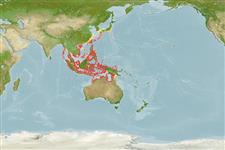
समुद्री प्रवाल-भित्ति संयुक्त; गैर प्रवासी; गहराई सीमा 1 - 15 m (Ref. 7247), usually 3 - 15 m (Ref. 55267). Tropical; 46°N - 17°S, 92°E - 147°E (Ref. 55267)
Indo-West Pacific: eastern Indian Ocean including Andaman and Nicobar Islands, Thailand, Malaysia, and northwest Australia to Singapore, Indonesia, and the Philippines; ranges north to Taiwan and the Ryukyu Islands.
आकार / वज़न / आयु
परिपक्व अवधि: Lm ? range ? - ? cm
Max length : 11.0 cm TL पुल्लिंग / अलिंग; (Ref. 9710)
पृष्ठीय रीढ़ (सम्पूर्ण) : 10 - 11; पृष्ठीय सौफट रेज़ (सम्पूर्ण) : 13 - 17; गुदा कांटा: 2; ऐनल सौफट रेज़: 11 - 13.
Body shape (shape guide): fusiform / normal; Cross section: compressed.
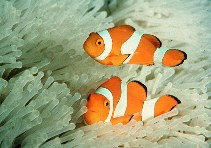
Adults inhabit coral reefs where it lives among the venomous tentacles of large sea anemones (Ref. 85309). Occur in shallow and calm lagoons. Are protandrous hermaphrodites (Ref. 32167). Distinct pair is monogamous (Ref. 32167). Oviparous, distinct pairing during breeding (Ref. 205). Eggs are demersal and adhere to the substrate (Ref. 205). Males guard and aerate the eggs (Ref. 205). One of the most popular marine aquarium fishes. Bred artificially in Florida for the aquarium trade. Associated with the anemones: Heteractis magnifica, Stichodactyla gigantea, and Stichodactyla mertensii (Ref. 5911). Has been reared in captivity (Ref. 35410, 35413, 35415, 35418, 35420). Has reached an age of 12 years in captivity (Alexandre Fontayne, pers. comm., 2006).
जीवन चक्र और संभोग व्यवहार
परिपक्व अवधि | पुनरुत्पत्ति | मछलीऔ का अंडे देना | अंडे | उपजाऊपन | लार्वा
Benthic spawner. Length at sex change = 4.4 cm TL (Ref. 55367). Oviparous, distinct pairing during breeding (Ref. 205). Eggs are demersal and adhere to the substrate (Ref. 205). Males guard and aerate the eggs (Ref. 205). Also Refs. 240, 7471, 118437.
Allen, G.R., 1991. Damselfishes of the world. Mergus Publishers, Melle, Germany. 271 p. (Ref. 7247)
आईयूसीएन रेड लिस्ट स्थिति (Ref. 130435: Version 2025-2 (Global))
मनुष्यों के लिए ख़तरा
Harmless
मानव उपयोग
मात्स्यिकी: कोई रुचि बग़ैर; जलजीवालय: व्यापारिक
साधन
विशेष रिपोर्ट
XML डाउनलोड करें
इंटरनेट स्रोत
मॉडल पर आधारित अनुमान
पसंदीदा तापमान (संदर्भ
123201): 26.2 - 29.3, mean 28.7 °C (based on 1746 cells).
जातिवृति विविधता सूचकांक (संदर्भ
82804): PD
50 = 0.5000 [Uniqueness, from 0.5 = low to 2.0 = high].
Bayesian length-weight: a=0.01445 (0.00624 - 0.03346), b=3.00 (2.81 - 3.19), in cm total length, based on LWR estimates for this (Sub)family-body shape (Ref.
93245).
ट्रॉफिक स्तर (संदर्भ
69278): 3.1 ±0.36 se; based on food items.
लौटाव (संदर्भ
120179): ऊंचा, न्यूनतम जनसंख्या दुगनी समय अवलागत 15 महीने। (tm<1; Fec=600).
मछली पकड़ने की भेद्यता (Ref.
59153): Low vulnerability (10 of 100).
🛈
पोषक तत्व (Ref.
124155): Calcium = 115 [69, 209] mg/100g; Iron = 0.909 [0.558, 1.451] mg/100g; Protein = 18.6 [17.5, 19.6] %; Omega3 = 0.142 [0.086, 0.235] g/100g; Selenium = 18.8 [10.6, 37.0] μg/100g; VitaminA = 223 [75, 636] μg/100g; Zinc = 1.84 [1.26, 2.60] mg/100g (wet weight);