Holocephali (chimeren) (chimaeras) >
Chimaeriformes (Chimaeras) >
Chimaeridae (Shortnose chimaeras or ratfishes)
Etymology: Hydrolagus: hydro-, combining form of hydor (Gr.), water; lagos (Gr.), hare, i.e., “water rabbit,” probably referring to three pairs of tooth plates, which tend to protrude from the mouth like a rabbit’s incisors (See ETYFish); melanophasma: melanos (Gr.), black, referring to color in life; phasma (Gr.), ghost or specter, alluding to the vernacular “ghostshark” (literally, a black ghost) (See ETYFish).
Milieu: milieu / Klimaatzone / Diepte / verspreidingsgebied
Ecologie
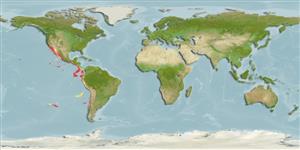
marien bathydemersaal; diepte 2 - 1720 m (Ref. 93040), usually 565 - 1720 m (Ref. 93040). Subtropical; 35°N - 40°S, 125°W - 70°W (Ref. 93040)
Eastern Pacific Ocean: From Baja California, Mexico to Validivia, Chile.
Grootte / Gewicht / Leeftijd
Maturiteit: Lm ? range ? - ? cm
Max length : 120 cm TL mannelijk / geslacht onbekend; (Ref. 82286)
A species of the genus Hydrolagus based on the absence of an anal fin. Hydrolagus
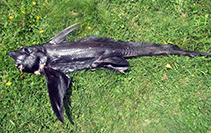
melanophasma sp. nov. is distinguished from other chimaeroids by a blunt snout with minimal sloping from the orbit to the snout tip, a large slightly curved dorsal fin spine (25.9 % BDL) extending beyond first dorsal fin apex, and a long second dorsal fin (77.3–81.1% BDL) of uniform height throughout. The pectoral fins are large, reaching beyond the pelvic fin insertion when laid flat, trifid claspers forked for 27–27.8% of the total clasper length and the preopercular and oral lateral line canals branch separately or together from the infraorbital canal. Coloration after preservation is a uniform black with no distinct mottling or markings (Ref. 82286).
Body shape (shape guide): elongated.
Levenscyclus en paargedrag
Maturiteit | Voortplanting | Paaien | Eieren | Fecunditeit | Larven
James, K.C., D.A. Ebert, D.J. Long and D.A. Didier, 2009. A new species of chimaera, Hydrolagus melanophasma sp. nov. (Chondrichthyes: Chimaeriformes: Chimaeridae), from the eastern North Pacific. Zootaxa 2218:59-68. (Ref. 82286)
Status op de Rode Lijst van het IUCN (Ref. 130435: Version 2025-2 (Global))
Gevaar voor de mens
Harmless
Gebruik door de mens
Tools
Speciale rapporten
Download XML
Internetbronnen
Schattingen op basis van modellen
Gewenste temperatuur (Ref.
123201): 2.6 - 6.5, mean 3.9 °C (based on 154 cells).
Fylogenetische diversiteitsindex (Ref.
82804): PD
50 = 0.5000 [Uniqueness, from 0.5 = low to 2.0 = high].
Bayesian length-weight: a=0.00339 (0.00139 - 0.00824), b=3.07 (2.86 - 3.28), in cm total length, based on LWR estimates for this (Sub)family-body shape (Ref.
93245).
Trofisch niveau (Ref.
69278): 4.0 ±0.6 se; based on size and trophs of closest relatives
Weerstandsvermogen (Ref.
120179): Zeer laag, minimale populatieverdubbelingstijd meer dan 14 jaar (Preliminary K or Fecundity.).
Kwetsbaarheid van de visserij (Ref.
59153): High to very high vulnerability (72 of 100).
🛈
Voedingsstoffen (Ref.
124155): Calcium = 17.4 [4.7, 51.6] mg/100g; Iron = 0.615 [0.214, 2.960] mg/100g; Protein = 16.4 [10.7, 19.5] %; Omega3 = 0.285 [0.125, 0.653] g/100g; Selenium = 54.7 [14.2, 174.3] μg/100g; VitaminA = 9.72 [2.86, 35.69] μg/100g; Zinc = 0.566 [0.279, 1.093] mg/100g (wet weight);