>
Cyprinodontiformes (Rivulines, killifishes and live bearers) >
Poeciliidae (Poeciliids) > Poeciliinae
Etymology: Cnesterodon: Greek, knester, -eros = scraper (Ref. 45335); pirai: The specific epithet pirai derives from the Guarani words “pirá”, meaning fish and the diminutive “í”, in allusion to the small size of the fishes belonging to the genus Cnesterodon. A noun in apposition.
Eponymy: This is not an eponym: Pirai is derived from the Guarani words that translate as ‘little fish’. (Ref. 128868), visit book page.
Entorno: milieu / zona climática / rango de profundidad / gama de distribución
Ecología
; agua dulce pelágico. Tropical; 27°S - 28°S
South America: Argentina. Only know from its type locality, arroyo Almeida, affluent of arroyo
Cuñá-Pirú, río Paraná basin, Aristóbulo del Valle, Misiones. In spite of the collecting effort in different streams of Misiones province, especially in the Cuñá-Pirú basin, C. pirai was not found in other sites (Ref. 82179).
Tamaño / Peso / Edad
Madurez: Lm ? range ? - ? cm
Max length : 2.8 cm SL macho / no sexado; (Ref. 82179)
Descripción breve
Claves de identificación | Morfología | Morfometría
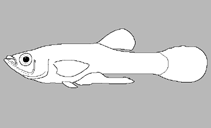
Cnesterodon pirai is diagnosed by the combination of the following characters: 6 to 8 irregular dashes on flanks, ranging from oval to vertical stripes on females and 7 to 9 irregular dashes ranging from oval to circular dots on males (dashes both on males and females covering 1 or 2 scales in transverse row); absence of a large post-gonopodium blotch on ventral profile in adult males; lack of a distal filament on
gonopodium; absence of longitudinal dark-brown band along flank; snout pointed and long (16.7–28.7 %HL); possession of 12–13 epipleural ribs; medial surface of ascending process of premaxilla approximately straight; presence of teeth on fourth ceratobranchial; distal portion of third and fourth gonactinosts separate, except by tip of third gonactinost; fifth gonactinost free; and presence of a constriction on unpaired appendix of gonopodium (Ref. 82179).
Ciclo vital y comportamiento de apareamiento
Madurez | Reproducción | Puesta | Huevos | Fecundidad | Larva
Aguilera, G., J.M. Mirande and M.d.I.M. Azpelicueta, 2009. A new species of Cnesterodon (Cyprinodontiformes: Poeciliidae) from a small tributary of arroyo Cuñá-Pirú, río Paraná basin, Misiones, Argentina. Zootaxa 2195:34-42. (Ref. 82179)
Situación en la Lista Roja de la UICN (Ref. 130435: Version 2025-2 (Global))
Amenaza para el ser humano
Harmless
Usos humanos
Herramientas
Informes especiales
Descargar XML
Fuentes de Internet
Estimaciones basadas en modelos
Índice de diversidad filogenética (Referencia
82804): PD
50 = 0.5010 [Uniqueness, from 0.5 = low to 2.0 = high].
Bayesian length-weight: a=0.00851 (0.00369 - 0.01962), b=3.15 (2.96 - 3.34), in cm total length, based on LWR estimates for this (Sub)family-body shape (Ref.
93245).
Nivel trófico (Referencia
69278): 3.0 ±0.4 se; based on size and trophs of closest relatives
Vulnerabilidad pesquera (Ref.
59153): Low vulnerability (10 of 100).
🛈