>
Cypriniformes (Carps) >
Catostomidae (Suckers) > Catostominae
Etymology: Catostomus: Greek, kata = down + Greek, stoma = mouth (Ref. 45335); utawana: The name is of Onondaga origin, Utawana (utowana, oo-ta-wan’-ne) and translates as ‘‘big waves’’ (species author noted the the word meant sunshins which is a misconception) (Ref. 83995).
Lingkungan: lingkungan / zona iklim / kisaran kedalaman / jangkauan distribusi
Ekologi
; air tawar dasar (demersal); potamodromous (Ref. 126106). Temperate
North America: Known only from the Adirondack Mountains of New York State, USA in the Saint Lawrence and Hudson River drainages.
Ukuran / Berat / umur
Kematangan: Lm ? range ? - ? cm
Max length : 10.0 cm SL jantan/; (Ref. 83995); 11.0 cm SL (female)
deskripsi pendek
Kunci identifiaksi (pengenalan) | Morfologi | Morfometrik
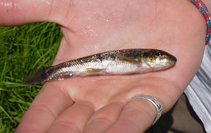
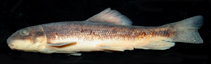
duri punggung lunak (Keseluruhan (total)) : 11 - 12; Sirip dubur lunak: 7. Catostomus utawana is distinguished from C. commersonii by the following characters: eye diameter twice or less into snout length (vs. more than twice into snout length); caudal peduncle depth at terminus more than twice into anal-fin length (vs. less than twice into anal-fin length for a small individual); dorsolateral scales of with radii in the dorsal ventral, anterior, and posterior fields (vs. scales with radii in the anterior and posterior fields); individuals rarely exceed 200 mm SL (vs. non-stunted adults of much greater lengths for C. commersonii). In breeding condition, this species is distinguished from C. commersonii by the following characters: pearl organs on anal and caudal fins and on scales found near the anal fin and ventral areas of the caudal peduncle on females (vs. none); pearl organs on nearly every scale and on all fins for males (vs. pearl organs on anal fin, caudal fin, and scales between); males with gold stripe above a dark mid-lateral stripe on both sides, and a gold spot above each eye (vs. a longitudinal white stripe that turns vertically to cross the occipital region or the snout, and no spots dorsal to their eyes); females without stripes (vs. a yellow stripe that resembles the white stripe of male C. commersonii); breeding males and females no red coloration (vs. a scarlet stripe on both male and female) (Ref. 83995).
Body shape (shape guide): elongated.
Adults inhabit hilltop lakes and streams, but is no longer known from its type localities. Individuals spawn once per reproductive season that extends from early June to late July or early August. Preferentially use ephemeral streams for spawning. Arrival at streams is episodic, correlating to precipitation events and appropriate flow. Stream temperature appears to be less important a cue for reproductive behavior than other Catostomus. Females always have pearl organs when in breeding condition; retain drab coloration when spawning. Males develop a gold longitudinal stripe, small gold-colored patch above each eye, and are extensively covered in pearl organs when in breeding condition. Both sexes start to reach sexual maturity at about 4 years. Eggs are about 3mm in diameter (Ref. 83995).
Siklus hidup dan perilaku kawin
Kematangan | Reproduksi, perkembang biakan | Pemijahan | telur-telur | Fekunditas | Larva
Morse, R.S. and R.A. Daniels, 2009. A redescription of Catostomus utawana (Cypriniformes: Catostomidae). Copeia 2009(2):214-220. (Ref. 83995)
Status IUCN Red List (Ref. 130435: Version 2025-2 (Global))
ancaman kepada manusia
Harmless
penggunaan manusia
Alat, peralatan
laporan khas
muat turun XML
Sumber internet
Estimasi berdasarkan model
Indeks keanekaragaman filogenetik (Acuan
82804): PD
50 = 0.5000 [Uniqueness, from 0.5 = low to 2.0 = high].
Bayesian length-weight: a=0.00537 (0.00228 - 0.01266), b=3.05 (2.84 - 3.26), in cm total length, based on LWR estimates for this (Sub)family-body shape (Ref.
93245).
Tingkat Trofik (Acuan
69278): 2.9 ±0.2 se; based on size and trophs of closest relatives
Daya lenting (Acuan
120179): Tinggi, Waktu penggandaan populasi minimum kurang dari 15 bulan (Preliminary K or Fecundity.).
Kerentanan Penangkapan Ikan (Ref.
59153): Low vulnerability (10 of 100).
🛈