Klassifizierung / Names
Namen | Synonyme | Catalog of Fishes(Gattung, Arten) | ITIS | CoL | WoRMS | Cloffa
>
Syngnathiformes (Pipefishes and seahorses) >
Syngnathidae (Pipefishes and seahorses) > Syngnathinae
Etymology: Hippocampus: Greek, ippos = horse + Greek,kampe = curvature (Ref. 45335); tyro: Named for the Dutch R/V Tyro.
More on authors: Randall & Lourie.
Umwelt: Milieu / Klimazone / Tiefenbereich / Verbreitungsgebiet
Ökologie
seewasser riff-verbunden; standorttreu; tiefenbereich 43 - 48 m (Ref. 82040). Tropical
Western Indian Ocean: Seychelles.
Größe / Gewicht / Alter
Geschlechtsreife: Lm ? range ? - ? cm
Max length : 6.1 cm TL (female)
Kurzbeschreibung
Bestimmungsschlüssel | Morphologie | Morphometrie
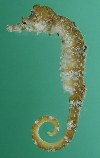
Rückenflossenweichstrahlen (insgesamt) : 15. This species is distinguished by the following characters: D 15; pectoral rays 14-15; rings on trunk 14; tail 38; subdorsal 3; subdorsal spines 4, forming a square, the dorsal 2 enlarged; spines blunt and moderate in size in trunk and tail ridges; third and seventh superior trunk spines, and fourth, eighth, and eleventh superior tail spines enlarged, with a slender, leaf-like filament; slender body, the maximum trunk depth (at seventh trunk ring) 11.2 in TL; depth of tail at third tail ring 23 in TL; trunk length 3.2 in TL; head at right angle to trunk as photographed (80° in preserved specimen); head length 6.2 in TL; snout length 2.2 in HL; eye diameter 6.25 in HL; suborbital 1, supraorbital 2, and 2 nose spines; coronet oval and cuplike in dorsal view, with a rugose spine to each side, followed by a narrow median ridge; anterior edges of coronet converging to a low, arrow-like, median spine; shoulder ridge continuous middorsally, followed by crest-like ridge; gill opening a single middorsal slit in neck ridge between coronet and collar of shoulder ridge; color when preservative uniform greyish white; when fresh light brown with whitish blotches, grading to light orangish brown posteriorly on tail, and to whitish ventrally on head and trunk; trunk and tail ridge spines white; filaments on spines dark brown. This species differs from H. pusillus in having a much greater head depth, 38 (vs.34) tail rings, and 14 or 15 (vs. 12 or 13) pectoral rays (Ref. 82040).
Body shape (shape guide): other.
Collected from coarse calcareous sand and coral (82040).
Lebenszyklus und Paarungsverhalten
Geschlechtsreife | Fortpflanzung | Ablaichen | Eier | Fruchtbarkeit | Larven
Male carries the eggs in a brood pouch (Ref. 205).
Lourie, S.A., R.A. Pollom and S.J. Foster, 2016. A global revision of the seahorses Hippocampus Rafinesque 1810 (Actinopterygii: Syngnathiformes): taxonomy and biogeography with recommendations for further research. Zootaxa 4146(1):1-66. (Ref. 115213)
IUCN Rote Liste Status (Ref. 130435: Version 2025-2 (Global))
Bedrohung für Menschen
Harmless
Nutzung durch Menschen
Tools
Zusatzinformationen
Download XML
Internet Quellen
Schätzungen auf der Grundlage von Modellen
Phylogenetischer Diversitätsindex (Ref.
82804): PD
50 = 0.5000 [Uniqueness, from 0.5 = low to 2.0 = high].
Bayesian length-weight: a=0.00447 (0.00176 - 0.01132), b=3.00 (2.78 - 3.22), in cm total length, based on LWR estimates for this (Sub)family-body shape (Ref.
93245).
Trophische Ebene (Ref.
69278): 3.2 ±0.4 se; based on size and trophs of closest relatives
Widerstandsfähigkeit (Ref.
120179): hoch, Verdopplung der Population dauert weniger als 15 Monate. (Preliminary K or Fecundity.).
Anfälligkeit der Fischerei (Ref.
59153): Low vulnerability (10 of 100).
🛈