>
Gobiiformes (Gobies) >
Gobiidae (Gobies) > Gobiinae
Etymology: Elacatinus: Greek, elakatines = fusiform fishes preserved in salt (Ref. 45335); lobeli: Named for Dr. Phillip S. Lobel of Boston University, who provided specimens, photographs, and biological data.
Eponymy: Dr Phillip S ‘Phil’ Lobel is a biologist and ichthyologist who is Professor of Biology at Boston University. [...] (Ref. 128868), visit book page.
More on authors: Randall & Colin.
Environnement : milieu / zone climatique / profondeur / gamme de distribution
Écologie
marin récifal; profondeur 0 - ? m (Ref. 81929), usually 0 - 17 m (Ref. 81929). Tropical; 17°N - 16°N, 88°W - 89°W
Western Central Atlantic: Caribbean Sea. Belize, Honduras (Ref. 81929).
Taille / Poids / Âge
Maturité: Lm ? range ? - ? cm
Max length : 3.1 cm SL mâle / non sexé; (Ref. 81929)
Description synthétique
Clés d'identification | Morphologie | Morphométrie
Épines dorsales (Total) : 8; Rayons mous dorsaux (Total) : 10 - 12; Épines anales: 1; Rayons mous anaux: 10 - 11. Dorsal rays VII + I, 10–12 (usually 11); anal rays I,10 (10–11, rarely 11); pectoral rays 15–17
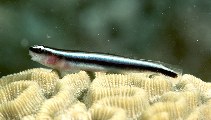
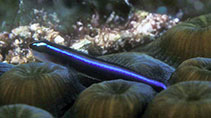
(usually 16); branched caudal rays 10–12 (usually 11); mouth ventral, the snout overhanging; tongue truncate; rostral frenum present; color in alcohol pale yellowish with a black stripe from front of snout, through lower half of eye, across upper part of operculum and dorsal third of pectoral-fin base, broadening along lower side
of body, to posterior end of caudal fin; a broad black middorsal stripe on snout, continuing onto postorbital head (where often divided medially), then along base of dorsal fin, joining to a single narrow stripe dorsally on caudal peduncle, and extending submarginally to end of caudal fin; color in life pale gray to white, with black stripes as described; a narrow, pale blue, pale yellow, or white stripe from anterior nostril through dorsal part of eye, continuing as a narrow bright blue stripe within lower part of pale gray stripe on upper side of body, and extending as a narrow blue band into caudal fin.
Body shape (shape guide): fusiform / normal.
Cycle de vie et comportement reproducteur
Maturité | Reproduction | Frai | Œufs | Fécondité | Larves
Randall, J.E. and P.L. Colin, 2009. Elacatinus lobeli, a new cleaning goby from Belize and Honduras. Zootaxa 2173:31-40. (Ref. 81929)
Statut dans la liste rouge de l'IUCN (Ref. 130435: Version 2025-2 (Global))
Menace pour l'homme
Harmless
Utilisations par l'homme
Outils
Articles particuliers
Télécharger en XML
Sources Internet
Estimations basées sur des modèles
Indice de diversité phylogénétique (Réf.
82804): PD
50 = 0.5000 [Uniqueness, from 0.5 = low to 2.0 = high].
Bayesian length-weight: a=0.01023 (0.00477 - 0.02194), b=3.01 (2.83 - 3.19), in cm total length, based on LWR estimates for this (Sub)family-body shape (Ref.
93245).
Niveau trophique (Réf.
69278): 3.3 ±0.3 se; based on size and trophs of closest relatives
Vulnérabilité de la pêche (Ref.
59153): Low vulnerability (10 of 100).
🛈
Nutriments (Ref.
124155): Calcium = 294 [136, 757] mg/100g; Iron = 1.4 [0.7, 2.8] mg/100g; Protein = 18.1 [16.1, 19.9] %; Omega3 = 0.17 [0.06, 0.40] g/100g; Selenium = 26.4 [10.2, 62.0] μg/100g; VitaminA = 141 [35, 554] μg/100g; Zinc = 3.55 [2.12, 5.54] mg/100g (wet weight);